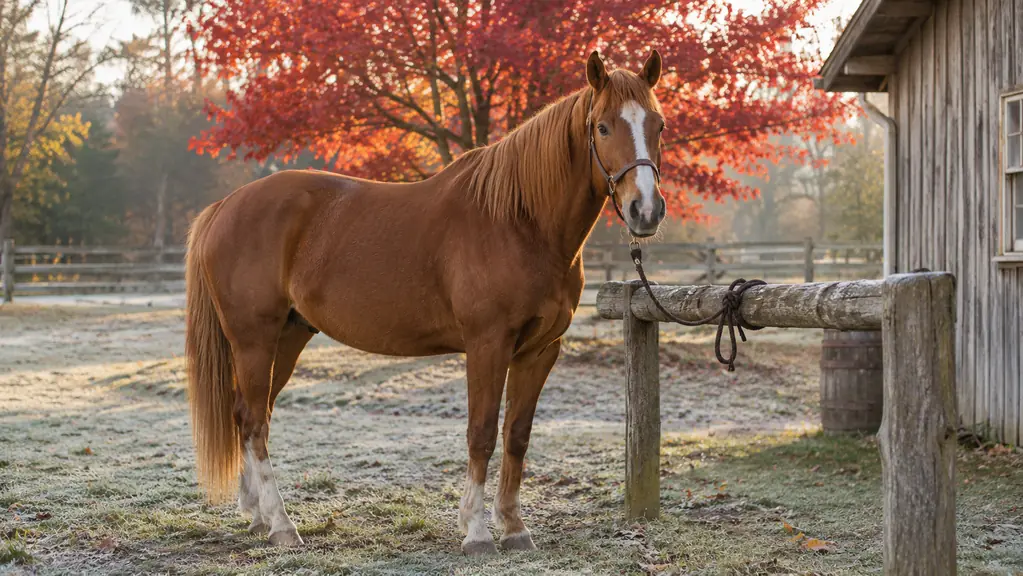
I bought the Weaver Equine Nylon Horse Halter in the fall of 2024, size Average Horse, because my old leather halter had gone stiff as a boot sole and I was tired of fighting it in the dark before an early ride. Two years later it still hangs on the same hook outside Sarge's stall. That is the short version, and it is where most halter reviews stop.
Here is the longer one. A halter is the piece of tack you touch more than any other, and almost nothing written about them is useful. You get a photo of a clean horse in a field and a sentence about how nice it looks. That does nothing for you at twenty degrees with gloves on, trying to work a snap while your horse leans on your shoulder. So this is the version I would want from a friend: what the Weaver Equine halter does well, where it irritates me, and the two situations where I would send you somewhere else.
The Quick Verdict
A plain, well-built nylon halter that has handled two years of daily leading, tying and farrier work without rubbing my horse. It is stiff, it is not soft, and it is not the halter I would choose for a horse that sets back and pulls.
Amazon Check Today's Price →Two years on the same hook, and the hair under the noseband grew back
One inch nylon webbing, Average Horse size, soft padded liner, brass plated hardware, snap closure. Nothing fancy, and that is the whole point.
Amazon Check Today's Price on Amazon →The Part Nobody Mentions: Nylon Is Not Leather
Most people shopping for a halter are comparing it to the leather one they already own, and that comparison is where the confusion starts. Leather stretches, dries out, cracks along the fold, and wants oil twice a year whether you feel like doing it or not. Nylon does none of that. It does not need conditioning. It does not soak up sweat and go sour in the tack room. When Sarge drags his head through the mud at the gate, I hose the halter off, hang it up, and it is dry by evening.
What you give up is feel. Nylon has no give in it. On a horse that respects a halter, that is fine, and honestly it is better than fine, because an inch of webbing does not stretch out over a season the way inexpensive leather does. On a horse that panics and sets back against the tie, a stiff webbing halter is a harder object against the skull than a leather one, and I would rather have leather in that moment. That is not a knock on Weaver Equine. It is the nature of the material.
The other thing nobody says out loud is that nylon is a seasonal material in a place like Vernon County. In July it is limp and easy in the hand. In January, when I lift it off the hook at six in the morning, it is stiff enough that I work the snap with both hands. It loosens in a minute against the horse's warmth. Two winters in, that has never cost me more than a little muttering.
How It Has Held Up Over Two Years of Daily Use
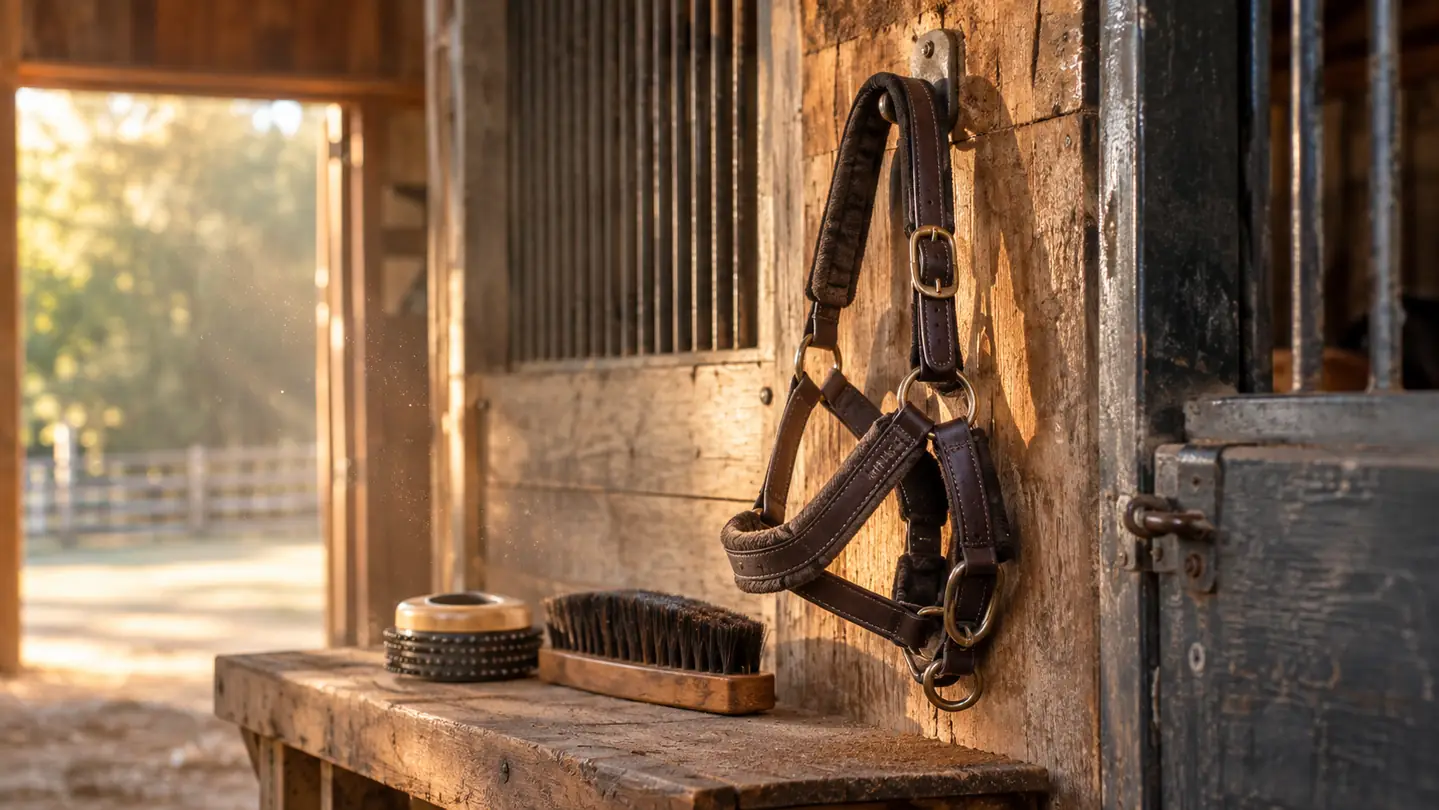
The Weaver Equine halter has had one real job and a hundred small ones. I lead Sarge in from the pasture with it every morning and back out every evening. I tie him to the trailer with it. My farrier uses it every six weeks. It has been clipped to a hitching rail at the Kickapoo Valley Reserve, draped over a fence post while I fixed a gate, and dropped in the mud more times than I will admit in print.
The webbing has not frayed. The stitching at the ring ends is still tight and shows no pulled threads. The padded liner behind the ears is intact. Where the wear shows is the hardware. The brass plating has dulled to a soft matte finish, and the ring that takes the most load has the shine worn off one edge. It is not failing. It just looks its age, the way a good tool should.
The mud is the real test up here. My gate opens onto a gravel lane that goes to soup from November through April, and Sarge drops his head and roots in it the moment I unclip the lead. Last March I pulled the halter off after a morning like that and it was caked from the cheek ring down to the throat snap. I hung it on the fence post and hit it with the hydrant hose for maybe thirty seconds, and by the time I had his blanket off it was dry enough to hang back up. Try that with a leather halter and you will spend the evening with a rag, a tin of conditioner and a bad attitude.
The stitching gets a look from me every few weeks, because that is what fails first on webbing. Where the cheek pieces fold around the ring, the thread is still sunk into the nylon the way it was when the halter was new. There is no fuzz, no pulled loop, no place where the needle walked off the edge. I have had a cheaper halter come apart at exactly that fold, and it came apart with a horse tied to a trailer, which is how you learn to check.
The padding is the part I watch, because that is where a cheap halter tells on itself. On the ones I have thrown away, the foam inside the noseband crushed flat within a season and the cover split at the edge. This liner has held its shape. It has compressed a little where it crosses the nose, which is normal, but it has not gone flat and the covering has not cracked.
What the Padding Actually Does
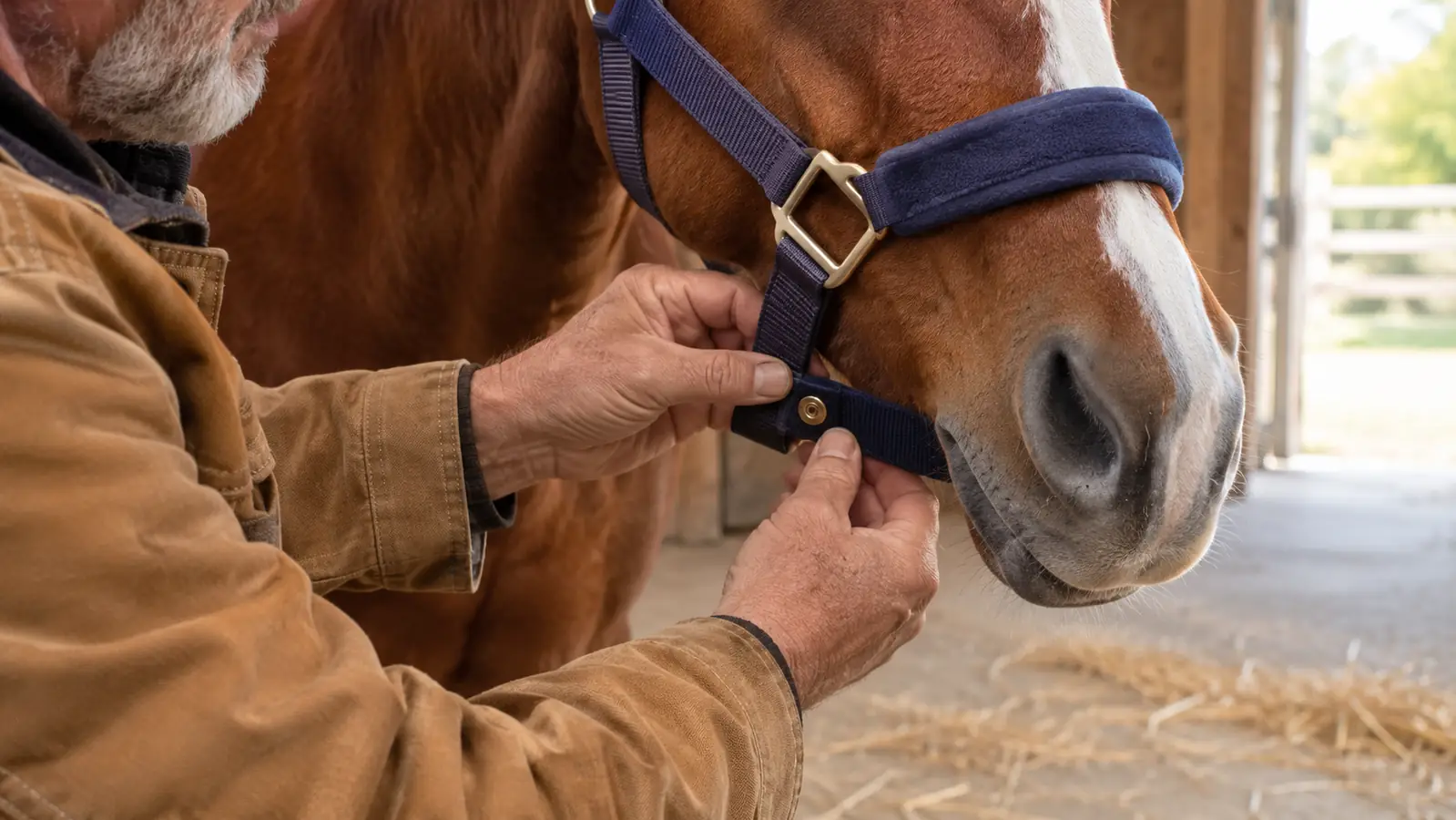
The listing describes it as a soft PVC-coated foam rubber liner, and that is an accurate description of what you feel with your fingers. It is a thin layer, maybe an eighth of an inch, wrapped over the webbing in the two spots that matter: behind the ears and across the nose. It is not a fleece cover, it does not add bulk, and it will not turn a badly fitted halter into a good one.
The liner stops about where the noseband ends, which is deliberate and correct. A halter that is padded all the way around the crown looks generous in a photograph and then holds heat and sweat against the horse's poll in July. This one leaves the webbing bare over the top of the head and behind the cheek, so air gets to the places that get hot. What it covers is the nose and the two spots behind the ears where a halter actually bears when a horse leans on a lead rope, which is where a rub starts.
What it does do is keep the edge of the webbing from working against the hair. The halter I used before this one had no padding at all, and it wore a thin spot across Sarge's nose that took a whole summer to fill back in. Since he has been wearing this one, that spot has stayed covered. I check under the noseband every time I take it off, out of habit, and I have not found a new one.
The thin spot my old halter wore across Sarge's nose took a whole summer to fill back in. Two years in this one, there is no new one.
That is a small thing that matters more than it sounds. A rub on a horse's face is not dramatic, but it is a daily irritation for the horse and a daily pang of guilt for the owner, and it usually comes from a hard edge in cheap webbing rather than from the horse being thin-skinned.
The Adjustment Is Where the Fit Is Won or Lost
Average Horse is a wide net. Weaver Equine sizes this halter for average breeds, and Sarge at 15.1 hands and about 1,100 pounds lands squarely in the middle of that range. But I have seen Average Horse fit a chunky gelding well and sit loose on a fine-boned mare of the same height. Before you buy, run a soft tape around your horse's nose just above the end of the bone, and leave yourself room to take the halter in or let it out.
I measured Sarge with a cloth tape the week the halter arrived, mostly because I wanted a baseline to compare against the old one. Around the nose, just above the end of the bone and clear of the cheek, he came in at about 22 inches. Around the throat, high up behind the ears and down under the jaw, about 38. The halter went on with the nose strap two holes off the end of its range and the crown strap close to the middle, which told me Average Horse was the right call for him and also that he was not near the edge of it. If your horse measures much past that on the nose, or noticeably under it, order a different size rather than talking yourself into Average Horse because it is the one in stock.
Where the halter sits on the head matters as much as the number. The noseband wants to cross the flat of the nose, a couple of fingers below the cheekbone, not up on the bone itself and not down near the nostrils where it will ride into the soft tissue. The crown piece sits behind the ears, and the cheek pieces should fall straight down from it without bowing out. I check all of that with two fingers in the same motion now, the way you check a cinch, and it takes about four seconds. Getting it wrong is not a catastrophe. It just means a horse who rubs his head on the stall wall after you leave.
A halter should let you get two fingers under the noseband and a hand's width under the throat. Tighter than that and you are asking for a rub and a horse who leans away when he sees you coming with it. Looser than that and he can rub it off on a fence post, which is how horses end up walking back to the barn without their headgear.
The adjustment on this halter is simple and it holds. I set it in the fall of 2024 and have not had to move it since, apart from a small tweak each spring when Sarge comes out of winter. Nothing has slipped under load. The snap closure is the part that takes getting used to, because it is a snap rather than a buckle, and a snap is faster once your fingers know it.
The Small Annoyances I Have Learned to Live With
The snap is slower with winter gloves on than a buckle would be, and there is no way around that. It is a two-handed job in December. It is also the reason the halter goes on and off in a second the other nine months of the year, so I have mostly stopped complaining about it.
Nylon slides on a slick coat. If your horse has been body-clipped, or is one of those horses that sweats up and stays slick, the halter will rotate a little on his head when he shakes. It has never come off, and it does not slip on Sarge, but I watched it happen on a clipped mare at the barn last fall and it is worth knowing before you buy.
The liner collects grit. It is a coated surface, so it wipes clean, but the seam where the liner meets the webbing can hold a little sand. Once a week I rinse it under the hydrant and let it dry in the sun, and that has been enough for two years of Wisconsin mud.
There is one more thing I want to be straight about, because it is the sort of thing a review will skip. This halter is not the one I would tie with if I were going to walk away. The snap closure is a good closure and it has never let go on me, but it is a snap, and a snap is a mechanical part that can be bumped open by a horse rubbing his head on a rail. When I tie Sarge to the trailer at the reserve, I run the lead through the tie ring and stand there with him. That is not a knock on Weaver Equine. It is how I was taught to tie, and it applies to every halter with a snap on it.
What I Liked
- Padded liner over the nose and behind the ears, and no rub after two years of daily use
- One inch nylon webbing has not frayed, stretched or lost stitching
- The adjustment holds where you set it, season after season
- Hoses off and dries fast, with no oiling or conditioning
- Snap closure is quick once your fingers are used to it
Where It Falls Short
- Stiff in cold weather, and the snap is a two-handed job with gloves on
- Nylon is unforgiving on a horse that sets back and pulls against the tie
- Brass plated hardware dulls with age and weather
- Average Horse is a broad size and will not suit every horse in that range
- The liner seam traps a little grit and wants a weekly rinse
Who This Is For
This is a good halter for the person I see most often at a small barn: one or two horses, daily handling, trail miles on weekends, and no interest in buying a new halter every spring. It is also a sensible choice for a horse that has already had a rub from a cheaper halter, because the liner covers the two spots where that usually happens.
It suits a horse that ties quietly and leads without drama. Sarge will lean on me now and then, and he has dragged back for half a second before giving to the lead, and this halter has handled both without complaint. I expect it to keep doing that for several more years. For the daily work it does, that is exactly what I want out of a piece of tack.
Who Should Skip It
If you have a horse that panics in the tie and throws himself backward, buy leather, and buy it after talking to someone who knows more about that problem than I do. A stiff webbing halter on a horse in a wreck is the wrong tool, and no amount of padding changes that. The tying problem itself is a conversation for your vet or a trainer you trust, not a shopping decision.
Skip it, too, if your horse falls outside the average range. A draft cross, a pony, or a very fine-headed young horse needs a different fit, and Average Horse will not be it. Measure the nose and the throat and let the numbers pick the size. And if you are looking for something to leave on in the pasture, this is not that halter for me. I take it off every single time, because I have seen what a halter caught on a fence post can do.
The halter I would buy again, and have not had to
Two years on a hook outside the stall, a farrier visit every six weeks, and a nose that has stayed clean the whole time. If that is what you want from a halter, this is the one I would point you toward.
Amazon Check Today's Price on Amazon →