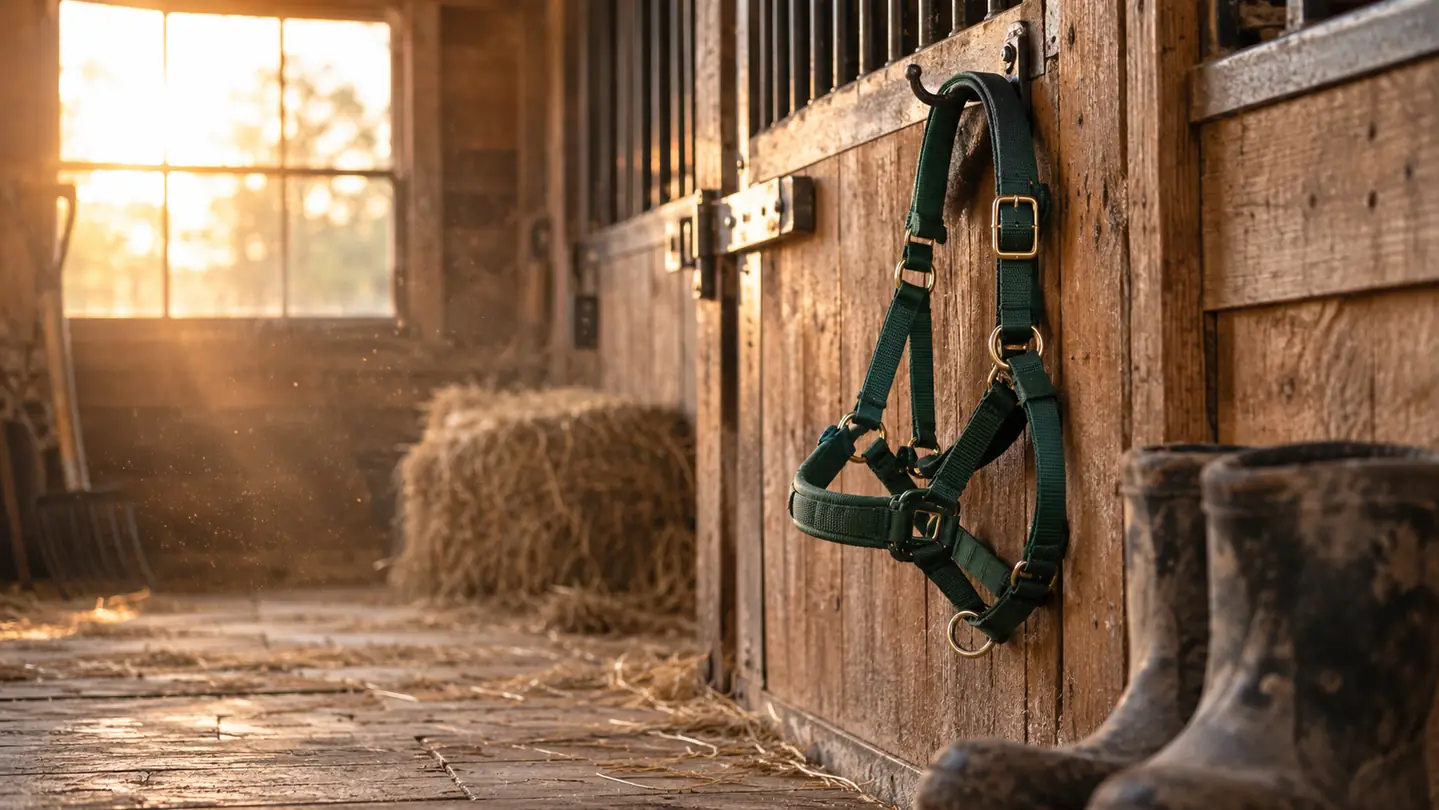
The halter hangs on a hook outside Sarge's stall, and I have reached for it every morning for about two years. That is not an exciting sentence. But it is the piece of tack I touch more than any other, and the piece that touches my horse's head every day.
Sarge is a 16-year-old bay Quarter Horse gelding, 15.1 hands, around 1,100 pounds, wide between the eyes and thin-skinned behind the ears. For years he wore whatever nylon halter was cheapest at the feed store. It did the job, and it left a pale band across his poll every winter.
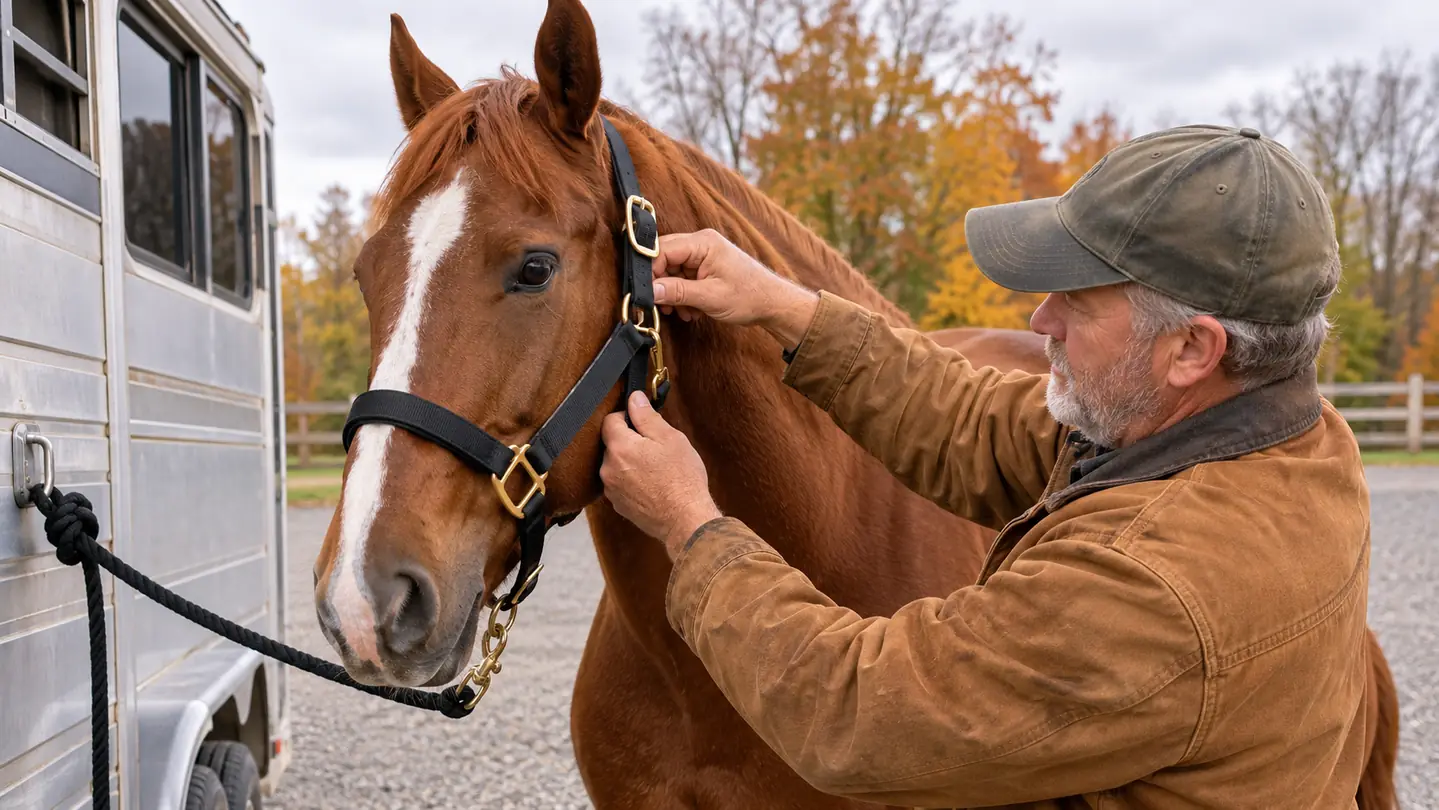
I keep a rope halter in the trailer and I am not giving it up. Rope has its place. But it is not what I want on a horse standing tied to a trailer while I eat a sandwich, and it is not what I want the farrier working around, either. Rope does not give. A wide nylon halter with padding in the right two spots does, which is how the Weaver padded nylon halter ended up on that hook.
I bought the Weaver halter in the fall of 2024, size Average Horse, one inch wide. It is the padded model with a soft PVC-coated foam rubber liner, brass plated hardware, and a snap closure. I cared about the width. One inch spreads the pull across more of his face than the narrower webbing on the halter it replaced.
Two years later it is still the halter on the hook.
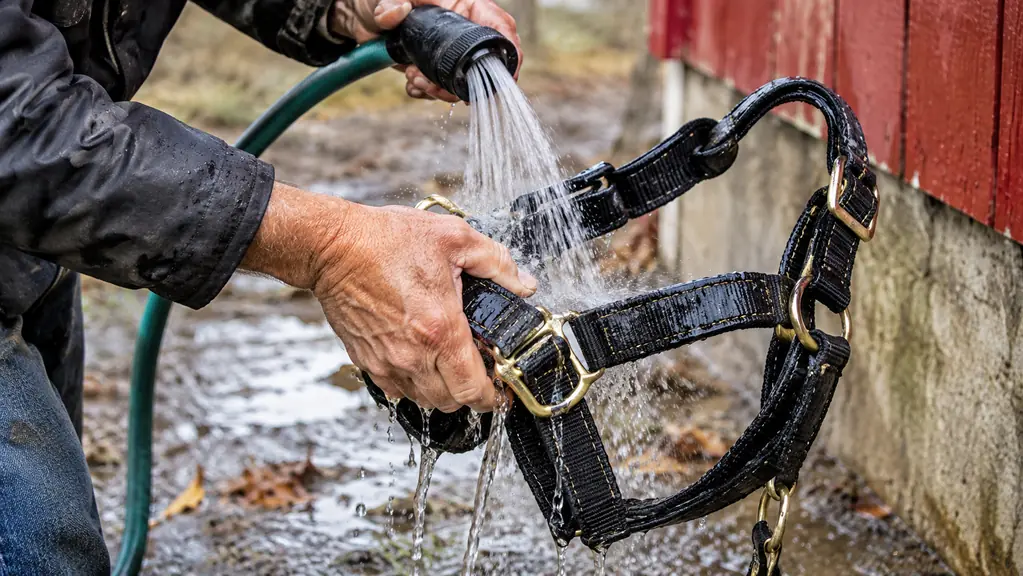
Two winters of mud, a farrier every six weeks, and a hundred rinses with the hose, and the padding under the crown has not flattened out or cracked.
The one I would buy again tomorrow
One inch nylon, a PVC-coated foam rubber liner, brass plated hardware, and a snap closure. Average Horse fits the average breeds, so put a soft tape on your own horse's head before you order rather than guessing.
Amazon Check Today's Price on Amazon →Here is what two years of daily use looks like. It goes on in the morning to lead Sarge in from the pasture. It goes on for the farrier every six weeks and for the vet once a year. It gets caked in mud in March, rinsed with the cold hose, and hung back on the hook. The nylon has not frayed at the cheek rings, and the liner has not peeled off the webbing, which is the failure I expected and did not get.
A 1,100 pound horse leaning on a lead rope is a lot of weight in your hand. The one inch width spreads that pull over more of his head, and he argues less about being led in from the far corner of the pasture when the wind is up.
The padding is the part that matters for us. On the Weaver halter the liner sits under the crown and across the nose, the two places a halter actually presses. The bare winter band behind his ears has not come back since I switched. He stands quieter for the farrier than he used to, and I think that is the halter and not a change of heart on his part.
Fit deserves ten minutes. Both the crown and the nose adjust on this Weaver halter, so the Average Horse size covers a fair range, but one inch of nylon is a lot of halter on a narrow head. It is right for Sarge at 1,100 pounds and a wide Quarter Horse head. If you have a fine-boned horse, a yearling, or something draft-bred, measure rather than assume. Two fingers under the noseband, crown behind the ears rather than on them.
I tie with it at the trailer, always with a quick-release knot, halter or no halter. The snap closure makes it quick to get on and off a horse that is dancing in the wind, and quick is worth something when you are 61 and the gelding is 1,100 pounds and convinced the hay is leaving without him.
What it will not do. It is not a breakaway halter, so it does not belong on a turned-out horse, and I do not leave it on Sarge in the stall either. It is not the tool for a horse that sets back and leans on a tied rope. That is a training problem, and no halter fixes it. The brass plated hardware will dull after a couple of seasons, which is cosmetic. The padded liner holds grit, so rinse it, or the grit does the rubbing you were trying to avoid.
My one small complaint: in a hard cold snap the liner is stiffer in the morning than it is in July, and I work the snap more deliberately with gloves on. That is the whole list. For leading, tying, and standing for the farrier, I have not found a reason to look at anything else.
What I'd Tell You If We Were Sitting at My Kitchen Table
Most people overbuy the saddle and underbuy the halter, then wonder why their horse gets sour about being caught. The halter is on his head every day. Put your money where the contact is.
If your horse already has a bare patch behind the ears or across the nose, look at what he is wearing before you look at anything else. A narrow, stiff webbing halter pulled snug will do that to a thin-skinned horse in one winter. Go wider, go padded, and check the fit with two fingers under the nose. If there is broken skin or swelling, that is a call to your vet, not a tack change.
And measure. The size on the package is a starting point, not a promise. Average Horse is right for Sarge, and I have seen that same size sit badly on a narrow Thoroughbred. Ten minutes with a soft tape beats a return label and a week of waiting.
Still the halter on the hook, two years in
If you are replacing a stiff, narrow halter that has been rubbing, start here and size it to your own horse. This Weaver halter is the one piece of tack on this place I would buy again without thinking twice about it.
Amazon Check Today's Price on Amazon →