I bought the Weaver Equine gel seat pad in the spring of 2025 for a selfish reason. Not for my horse. For me. My hips had started talking to me somewhere around hour two of a ride, and by hour three the talk had turned into a complaint I could not ignore. I am 61, I keep Sarge at home on eleven acres outside Viroqua, Wisconsin, and I ride him about three times a week from April through November. My long rides run close to four hours. That is a lot of time to sit on hard leather and pretend everything is fine.
So I did what most people do. I read the listing, I read maybe forty reviews, and I bought the thing hoping it would fix a problem it was never built to fix. Eighteen months later I know exactly what this pad does, what it does not do, and why so many of the reviews written about it are answering the wrong question. What follows is the honest version, including the part where I bought it for the wrong reason and the part where it turned out to be worth keeping anyway.
The Quick Verdict
A real comfort upgrade for the rider on long rides, and an easy thing to live with. It is a seat pad, though. It will not fix a saddle that does not fit your horse, and it will not fix your horse.
Amazon Check Today's Price →If your seat gives out before your horse does, this is worth a look
Half an inch of gel under the rider, a mesh cover on top, a strap that runs down under the saddle, and a fit that covers 15, 16 and 17 inch western seats. Mine has lived on my saddle for eighteen months without a single adjustment.
Amazon Check Today's Price on Amazon →How I've Used It, and Where It Lives
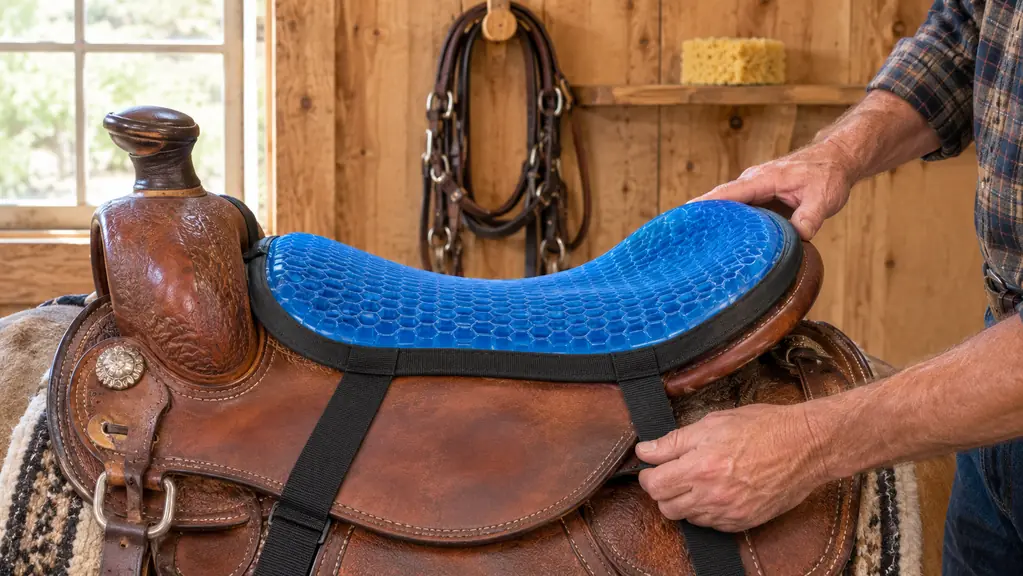
There was nothing to assemble. It is a slab of gel wrapped in mesh, 13 inches wide by 24 inches long by half an inch thick, two pounds, with a strap closure that runs down under the saddle and holds it in place. It sits on top of the seat, under the rider. For eighteen months it has lived on my saddle on the rack in the tack room, which tells you the most useful thing about it. I put it on once in the spring and I never took it off.
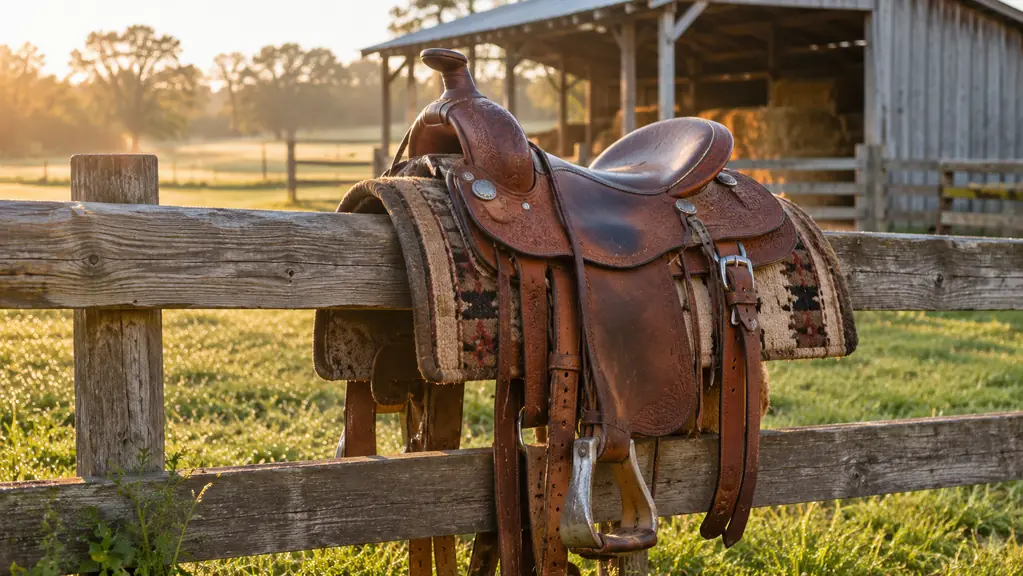
My saddle is a secondhand Western trail saddle with full Quarter Horse bars, bought used about twelve years ago, and the leather has darkened with age. Sarge is a 16-year-old Quarter Horse gelding, 15.1 hands, about 1,100 pounds, with withers wide enough that saddle fit has always been a negotiation rather than a given. The pad is built for 15, 16 and 17 inch western seats and mine falls inside that range, so it lies flat, sits inside the skirt, and does not bunch at the cantle.
We ride the Kickapoo Valley Reserve and the county trails near home. Three days a week, April to November, and the long rides run near four hours with a stop for lunch. That is the test window I care about. A pad that only works for the first hour is not a pad, it is a cushion, and you find out the difference at hour three.
The Part Nobody Tells You: It Never Touches Your Horse
Here is what I wish someone had said to me plainly, in bold, at the top of the listing. This is a gel seat pad. It straps to the top of the saddle seat, under the rider. It is not an under-saddle pad. It does not go between the saddle and the horse. It does not touch Sarge at all. If you came here hoping to fix a sore back, a dry spot, a saddle that rocks, or a horse that flinches when you set the saddle down, this is not that product, and no amount of gel in the world will make it that product.
I say that because a fair share of the reviews I read before buying seem to have been written by people who expected something else. Some of them, I suspect, were written by people who never got the saddle fit question answered and blamed a seat pad for it. That is not fair to the pad. It is also, if I am honest with myself, exactly how I ended up buying it. I had a problem in my own hips and I wanted it to be a gear problem, because a gear problem can be solved with a purchase. Most of them cannot.
The gel does one job and it does that job under your seat bones. Once I stopped expecting it to do a second job, I stopped being disappointed and started noticing what I had actually bought.
It never touches the horse. Once I understood that, I stopped being disappointed and started being comfortable.
What the Gel Actually Does, in My Own Body
The listing says the gel insert absorbs shock and spreads rider weight more evenly across the seat. I cannot measure that and I am not going to pretend I can. What I can tell you is what changed. By the end of a four hour ride I used to have a specific ache at the point of each hip and a tenderness at the tailbone that took an hour to fade once I was off. Within the first month of using the pad, that ache was quieter. Not gone. Quieter. Eighteen months in, on a normal four hour ride, I get off and walk like a person, and that was not true in the spring of 2025.
The half inch of gel does two things at once, as near as I can tell through the leather. It takes the sharpest edge off the seat, and it lets me sit a little deeper without the front of the seat digging in. On a long ride the difference between sitting on leather and sitting on half an inch of gel is not dramatic in any single moment. It accumulates. Hour three is where you feel what you paid for.
The mesh cover is the part I did not expect to care about. It breathes better than bare leather, and in July and August that matters more than I would have guessed. I have not once had that damp, stuck feeling on the seat after two hours in the heat. Weaver Equine lists the material as nylon and describes it as heat resistant. All I can report is that after eighteen months of sun, sweat, and being left on the saddle in an unheated tack room, it has not gone soft, cracked, or shiny.
Fit Details That Decide Whether You Keep It
The pad measures 13 inches by 0.5 inches by 24 inches and weighs two pounds. The half inch is the number that matters most, because it changes your seat depth. If your saddle already fits you snugly, adding half an inch under you will feel like a different saddle. Mine was a touch roomy, and the pad filled it out in a way I liked. If yours is already tight, you may feel crowded up against the horn, and you will want to try before you commit.
It is designed for 15, 16 and 17 inch seats, which covers most western saddles people actually ride. The strap closure runs underneath and holds it down. Mine has not shifted on a mount from the ground, and it has not slid back on steep downhills, which are the two places a seat pad gives itself away.
Two pounds does not sound like much until you are lifting a western saddle onto a 15.1 hand horse with a shoulder that has opinions. I notice it. Not enough to take the pad off, but I notice it, and if you already struggle with the weight of your saddle you should know this adds to that number rather than subtracting from it.
Eighteen Months Later: How It Has Held Up
This is the part I can speak to better than a person who has owned it for a month. The gel has not migrated, flattened, or gone hard at the edges. The gel insert still feels like gel under a thumb. The mesh cover has a little dust ground into it that a damp sponge takes off, and the stitching at the strap attachment points has not frayed. The strap still holds. Nothing has cracked, and nothing has started to smell, which is more than I can say for some things that live in a tack room.
The pad has been rained on twice when I got caught out, and left to dry on the saddle rack. It came back without a mark. I have not conditioned it, treated it, or done anything to it beyond wiping it down. That is the entire maintenance routine after eighteen months, and I want to be clear that this is a genuine advantage over leather and over sheepskin, both of which want attention.
I also run Weaver Equine gear elsewhere on this horse, and the pattern holds. I replaced a set of leather split reins with their poly roper rein after I dropped one in the mud and stepped on it, and I moved to their felt lined Smart Cinch after Sarge came up with a rub behind his left elbow. None of that is the same product, but it tells you something about why I was willing to buy this pad in the first place.

The Small Annoyances
Nothing here is a deal breaker, but a review that only lists the good parts is not a review. The pad is a little awkward to carry separately. When I take the saddle off and set it on the fence, the pad comes with it, and if I am not careful it slides off onto the ground. Twice I have found it in the dirt. That is my fault, not the pad's, but it is the kind of small friction you learn to live with.
The other thing is that it does not breathe through the bottom. The mesh helps on top, but the underside is gel and it does not let air through, so on a genuinely hot day you will feel a warm patch under you that you would not feel on plain leather. It is not uncomfortable. It is just warm. If you ride in serious heat, know that going in.
Where It Falls Short
The pad does not fix saddle fit, and I want to be as clear about that as I can. Sarge's wide withers are a real problem that a seat pad cannot touch. If your horse is sore over the loin, hollow behind the shoulder, or flinching when you set the saddle down, you need a saddle fitter and quite possibly a vet. That is not a gear problem and no product on a listing page will solve it. I had my fit checked and I use a proper under-saddle pad for that job. Nothing here should talk you out of either.
It also does not make you a better rider. If you are bracing against the horn, gripping with your knees, or sitting behind the motion, a gel pad will make the bracing more comfortable and it may take longer for you to notice the bracing at all. I say that as someone who spent a year bracing and did not know it. Comfort is worth having. It is not the same thing as a fix.
How It Compares to a Sheepskin Seat Saver
I have ridden in a friend's sheepskin seat saver, and the honest comparison is short. Sheepskin is softer, warmer on a cold morning, and it feels better against you. It also holds heat and dirt, wants brushing, and needs airing out. The gel pad is firmer, thinner, and far easier to live with. I wipe the mesh with a damp sponge when it looks dusty and that is the whole routine.
If you want the softest possible thing under you on a frosty October morning, sheepskin wins and it is not close. If you want something you can strap to the saddle in April, forget about until November, and know it will be the same shape when you come back, the gel pad is the better answer. They are not really competing. They solve different problems, and one of them is laundry.
What I Liked
- Noticeably less hip and tailbone ache on four hour rides, felt within the first month
- Stays strapped to the saddle, so there is nothing to remember before a ride
- Mesh cover stays dry in July heat and wipes clean with a damp sponge
- Gel and stitching have held up through eighteen months of use, rain, and cold storage
- Fits 15, 16 and 17 inch western seats and sits inside the skirt without bunching
Where It Falls Short
- It is a seat pad, not an under-saddle pad, and it never touches the horse
- Adds half an inch of seat depth, which crowds you if your saddle already fits tight
- Adds two pounds to a saddle you may already find heavy to lift
- The gel underside does not breathe, so it runs warm on very hot days
Who This Is For
You are the right person for this pad if you are a pleasure or trail rider who sits for two hours or more at a stretch, and it is the seat of the saddle rather than the fit of it that is wearing you down. If your hips, tailbone or seat bones ache after a long ride, and your saddle fit has been checked and is correct, this is a sensible thing to try.
It also suits anyone who wants a pad they can leave on. I fitted it in the spring and it stayed fitted. No rolling it up, no storing it flat under something heavy, no remembering to bring it. For a person who rides out of a home barn alone most days, that matters more than it sounds like it should.
Who Should Skip It
Skip it if the problem is your horse, and skip it if you have been told your saddle bridges, rocks, or sits low in front. Skip it if your seat is already snug and you like a deep seat, because half an inch will change what you feel under you and not everyone wants that. And skip it if you are looking for a pad that goes under the saddle, because that is a different product with a different job.
One more. If you are buying this to solve a problem you have not actually diagnosed, do the boring thing first. Have someone watch you ride. Have your saddle checked. Borrow a friend's seat saver for one long ride. I bought this pad for a reason that was half wrong and got lucky that the other half was right, and luck is not a buying strategy.
Eighteen months, one strap, and no regrets about the pad itself
If your ache is in your seat and not in your horse, this is the simplest thing I have found that helps. Half an inch of gel, a mesh cover, and a fit that covers 15, 16 and 17 inch western seats.
Amazon Check Today's Price on Amazon →