
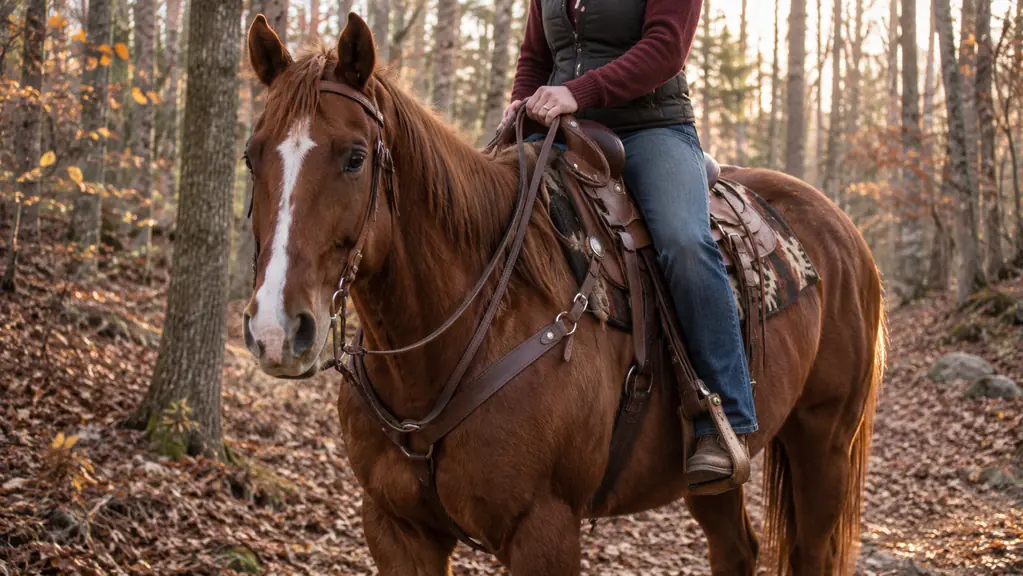
I dropped my split reins in the gravel outside the barn on a Tuesday in June, and then I stepped on them. Not a glancing step, either. A full-weight, heel-first step with a muddy boot on. The leather had been drying out all spring and it cracked clean through about a foot below the bit end. So I stood there holding two pieces of rein with a horse who wanted his dinner, and I decided I was finished pretending I was careful enough for split reins. That is how the Weaver Equine Poly Roper Rein ended up on my bridle. One continuous loop, 3/8 inch by 8 feet, leather water loops at the ends, nickel plated scissor snaps. I bought it in the summer of 2025 and it has been on Sarge's bridle for about fifteen months.
For context, I am 61, I keep one horse on eleven acres outside Viroqua, Wisconsin, and I ride three times a week from April into November, mostly on the Kickapoo Valley Reserve and the county trails north of me. Sarge is a 16-year-old Quarter Horse gelding, 15.1 hands, about 1,100 pounds. My regular loop runs two hours. The long ones go about four. I am not a trainer, I do not compete, and nobody is paying me for this. What follows is what a home horse owner noticed over a year and a bit of ordinary use, including the parts I did not care for.
The Quick Verdict
A plain, hardworking loop rein that came through mud, rain, cold and one bad habit of mine without cracking or stretching. The scissor snaps are the part that needs looking after, not the rein.
Amazon Check Today's Price →The rein that survived being stepped on, a wet spring, and a spooked horse
One continuous loop, 3/8 inch by 8 feet, leather water loops and nickel plated scissor snaps. Fifteen months on my own bridle and still hanging on the same peg.
Amazon Check Today's Price on Amazon →How I've Used It
The rein lives clipped to the bridle on a peg in my little tack room. I do not take it apart between rides. I unbuckle the bridle, hang the whole thing, and go do the rest of the chores. That sounds like a small thing and it is not. With my old split reins I was forever pairing them up, laying them out straight, and finding one of them on the trailer floor where it had slid off the fender.
The first week took some getting used to. A loop rein is one piece, so there is no second rein to take up slack in your other hand. Everything happens in your left hand with the tail end draped across. I rode Sarge in the round pen at home for a few days before I took it out on trail, and I am glad I did, because the first time he blew up at a grouse I had a fistful of loop and nowhere to put it.
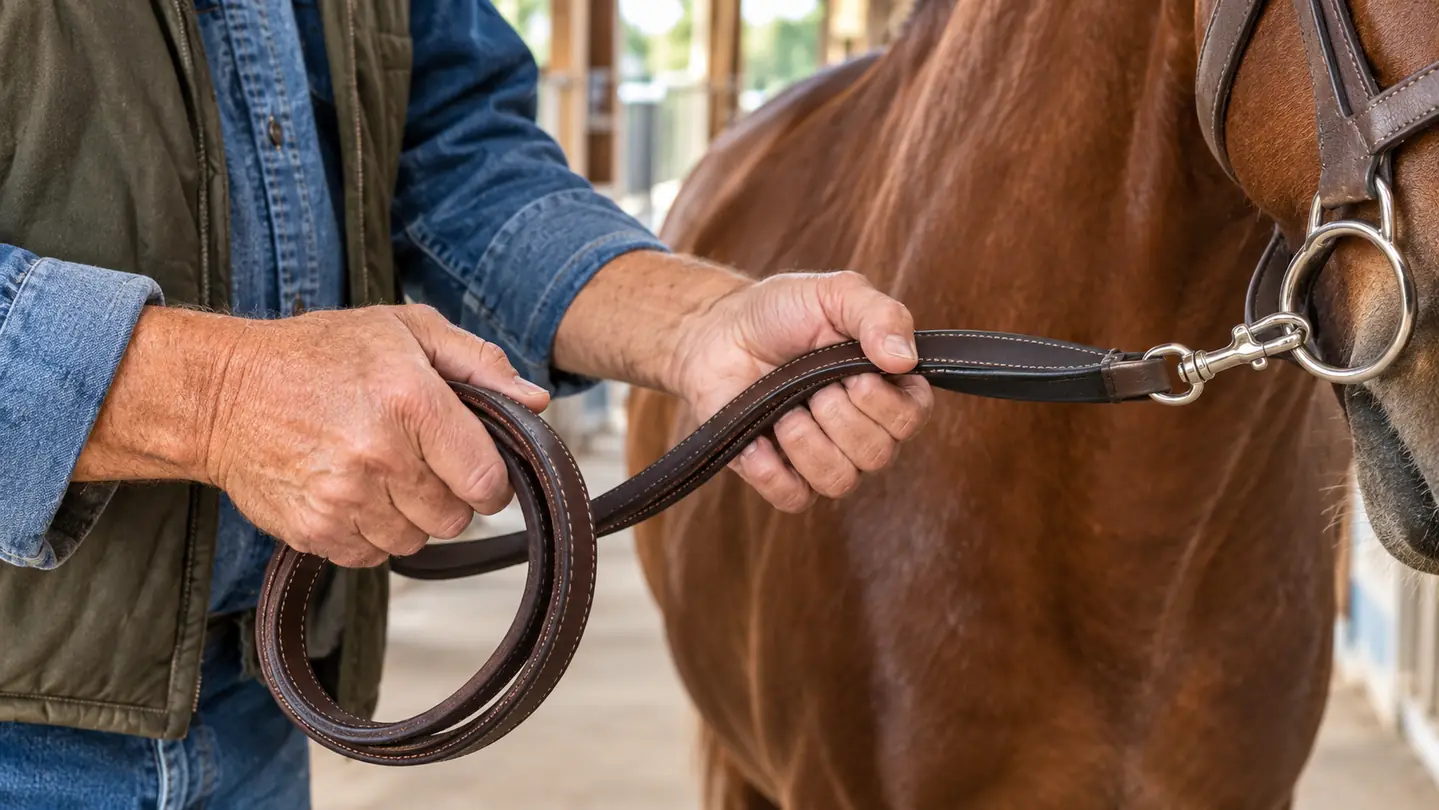
What I settled into is this. Left hand carries the loop. Right hand does what it always did. If I need to get off and lead, or open a gate, or deal with a cinch that has slipped, I unclip one scissor snap and the rein comes free, and it goes back on in about three seconds. That is the piece that sold me. With splits, getting off meant looping them over the horn and hoping the horse stood still.
There is one ride I keep coming back to. Late July, the reserve a week after heavy rain, and the low crossing below the second bridge running higher than I like. I got off, unclipped the near side, led Sarge through on a loose loop gathered in my hand, and clipped back on standing in six inches of moving water. Ten years ago I would have been up on the bank trying to drape two wet reins over the horn and hold a horse at the same time. That is not a small thing when the ground under your boots is slick and the horse is in a hurry.
What a Continuous Loop Changes About Your Hands
The honest answer is that poly does not feel like leather. It has a little more slip to it, and it will not soften and darken the way a good set of leather reins does after a season. In the first month I missed the weight of leather in my hand. By the second month I had stopped thinking about it, which is how I know it was fine.
What surprised me is how much I use the loop as a rest. Eight feet is enough rein that on a long ride I can lay a fold of it across my thigh and let my hand go soft, and Sarge keeps on the way he was going. With split reins I could do something similar, but the ends would slide off my leg and I would have to fish for them one at a time.
One thing I did not expect is that my shoulders are less tired at the end of a four-hour ride. I am not going to claim a rein fixed my posture, because I do not know that. What I do know is that riding three times a week for a whole season with one hand on one loop felt easier than the same season with two reins I was constantly adjusting.
The Water Loops and the Scissor Snaps
Weaver Equine builds this rein at Mt. Hope, Ohio, and the way the ends are finished tells you somebody thought about it. Instead of a stitched splice or a metal ferrule, the poly runs through a leather loop held with laces, which is what they call the water loop, and the scissor snaps hang off that.
I like the water loops. In fifteen months of rain, mud, and one accidental dunking in the Kickapoo, they have not stretched out or pulled loose. When they get dirty I wipe them with a damp rag and a little saddle soap and let them dry on the peg. They are the most leather-like part of the whole piece, and they are also the part that takes the abuse.
The laces are the piece I watch. If one ever worked loose I would want to catch it before the loop opened up, so about once a month I run the whole rein through my hands end to end and look it over. Nothing has moved yet. For comparison, the old leather reins I retired had a stitched splice at the bit end that started lifting threads two seasons in, and I never fully trusted it after that. The water loop does not have that problem, because there is no thread to break.
The snaps are nickel plated and they are sturdy, but they are the piece that needs attention. Fine grit works into the hinge. Two or three times this past summer I found one of them stiff when I went to clip on. A drop of oil and working it open and closed a few times fixed it every time. If you are the sort who never cleans tack, plan on the snaps getting cranky before the rein ever does.
One more word about the snaps, because it matters more than I expected at my age. They are quick. Being able to unclip one side, lead the horse through a gate, and clip back on without unthreading anything is the difference between getting off twice on a ride and getting off never.
Fifteen Months, Four Seasons, One Very Muddy Spring
It went on in summer. It stayed on through the fall, through the wet spring when the reserve trails turn into a creek, and through this past summer. Wisconsin weather is not gentle on gear. The poly never cracked, never went brittle in the cold the way neglected leather will, and never took a permanent set from being looped over the horn for hours at a time.
February was the test I did not plan for. I rode one afternoon with the temperature around twenty-eight and crust on the snow, and the rein hung stiff off my hand for the first half mile. Poly does firm up in real cold. What it does not do is crack at the fold, which is what my old leather did one January before I knew better than to leave it in the trailer. By the time we were a mile in it had warmed enough to move like normal. My bridle leather was not so lucky that day, and I spent that evening with a rag and a tin of soap.
It did get dirty, and unlike leather you cannot bring it back with conditioner. Poly is poly. Wipe it off and it looks the way it looked. My one cosmetic complaint is that grit seems to cling to it more than it does to leather, especially when there is mud drying on the horse's neck and the rein keeps dragging through it.
The thing I actually judge a rein by is whether it does its job when the horse does something stupid. Sarge is 16 and mostly sensible, but in September a deer came out of the fencerow and he spun. I had the loop in my hand. It did not slide out, it did not burn through my fingers, and it did not come off the horn. I got him stopped. Then I sat there a minute with my heart going and thought well, that is the answer to that question.
Where It Falls Short
The loop is the drawback as much as it is the advantage. Because the rein is one continuous piece, if it comes off the horn there is nothing to catch it. I had it swing down and drag once, when I stepped down and did not take the loop with me. It did not break. It did teach me to keep it over my arm when I dismount, and I have not made that mistake twice.
Second, poly is slicker than leather when everything is soaked. Not dangerous slick, but on a rainy ride you will notice your hand working a little harder to hold contact. Third, this rein asks for a fairly fixed hand position compared to splits. You are not taking up slack and letting it out the way you would with two reins. That is not a flaw in the Weaver Equine rein, that is what any loop rein is, but it is a real adjustment for somebody who has ridden splits for thirty years.
And there is no way around this one: it will never look like anything. My saddle is twelve years old and the leather has gone dark and soft and it looks like something my grandfather left me. The rein looks like a rein. If you want tack that improves with age, this is not that.
One more thing, and this is about the horse rather than the rein. Sarge carries a heavy neck and he will lean on a hand if you let him. Poly has no give in it at all, so leaning does not stretch it out of shape the way it will a cheap leather rein over a season. That is an advantage right up until you realize it also means you feel every ounce of him coming down the rein. There is no softness in the material to soak any of that up. By the end of a four-hour ride my left forearm knows exactly how much horse I am holding.
What I Liked
- Leather water loops held for fifteen months without stretching or pulling loose
- Nickel plated scissor snaps make leading, gates and remounting quick
- 3/8 inch by 8 feet gives enough rein to fold into your hand and rest on your thigh
- Did not crack, go brittle, or take a set through a Wisconsin winter and a wet spring
- One continuous loop means nothing to pair up and nothing to drop half of
Where It Falls Short
- Scissor snaps pick up grit and need a drop of oil now and then
- Poly feels slicker than leather in steady rain
- Cannot be conditioned back to softness the way leather can
- No second end to catch it if the loop slides off the horn
- Grit clings to it more than to a leather rein
In fifteen months of rain, mud, and one accidental dunking in the Kickapoo, the water loops have not stretched out or pulled loose.
Who This Is For
If you are a trail rider who has ever gotten off a horse in a place where you did not want to be fiddling with two reins, this will make your day simpler. The scissor snaps are the whole argument. Clip on, ride, unclip, lead, clip back on. I have done that at gates, at a washed out creek crossing, and once at the far end of the reserve when Sarge picked up a stone in his hoof.
It also suits a rider who is not interested in fussing. I brush the felt on my cinch, I soap my saddle about once a month in season, and that is the extent of my tack maintenance. This rein fits that kind of barn. Wipe it down when it is filthy, oil the snaps when they stiffen, hang it up. Fifteen months in, that is all it has asked of me.
It is a good match for the older rider, too, and I say that as one. My hands are not what they were at forty. I have a touch of arthritis in my right thumb and I do not grip like I used to. One loop that I can rest on my thigh and pick back up beats two reins that need managing every few minutes. I rode four hours on the reserve in October and got off with my hands feeling fine, which was not true five years ago.
Who Should Skip It
If you ride with a light, moving feel and you are used to taking up one rein and giving the other, this will frustrate you. A loop rein is a fixed amount of rein. Riders who work a horse off a lot of feel, and riders in disciplines where two reins do specific jobs, should stay with what they have. Nothing here converts anybody.
Skip it too if you want tack that looks like something. There is no breaking in period that turns this into a showpiece. And if you have a green horse who has learned to duck his head and get a rein over his neck, a continuous loop gives him a bigger target than splits do. Get that sorted with a trainer first, and get a saddle fitter out for any soreness issue, because no rein fixes a back problem.
After fifteen months on one bridle, I would buy it again
One loop, 3/8 inch by 8 feet, leather water loops, nickel plated scissor snaps, built by Weaver Equine. It is not fancy. It has not given me a moment of trouble on trail.
Amazon Check Today's Price on Amazon →