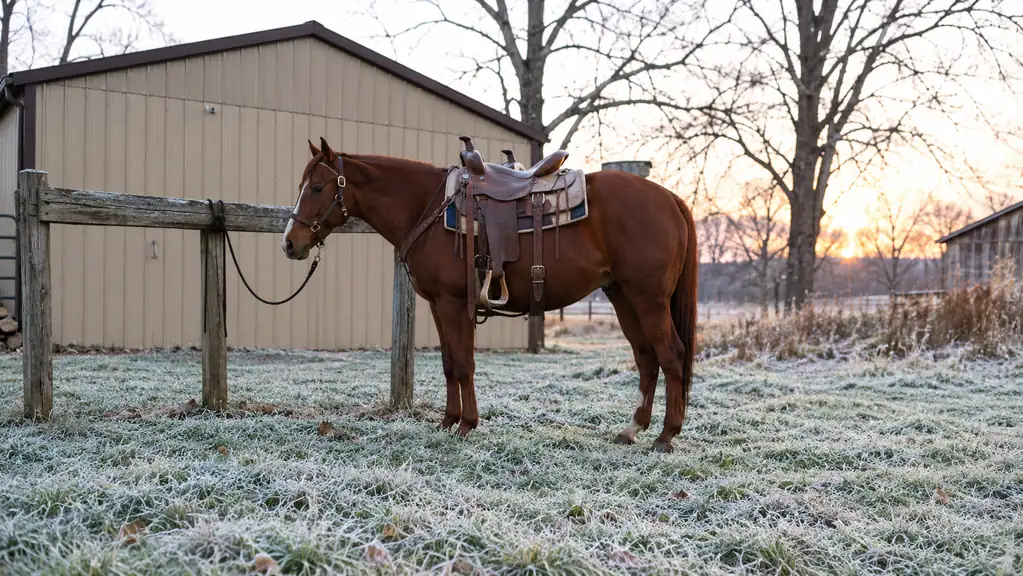
The rub showed up behind Sarge's left elbow in the spring of 2024, a patch about the size of my palm where the hair had worn thin and the skin underneath had gone pink and tender. He is a 16-year-old bay Quarter Horse, 15.1 hands, about 1,100 pounds, and his withers are wide enough that my old trail saddle has always wanted to creep forward. I cleaned the spot. I let it dry. Then I did what most of us do first, which is blame the pad.
It was not the pad. It was a string cinch that came on that secondhand Western saddle about twelve years ago, and once I got honest about it, that cinch had been taking a fold of skin with it every time I pulled it up. What fixed the problem was smaller than I expected: a different cinch, a tape measure, and a change to the way I tighten. I have used a Weaver Equine Felt Lined Smart Cinch since April 2024, close to two and a half years now, roughly three rides a week from April through November, and that rub has not come back. Here is the whole process in the order I would do it again.
The cinch that ended the rub behind the elbow
A poly webbing top, a 1/2 inch polyester felt liner that sits against the horse, and non-rust stainless steel hardware. Weaver Equine lists it as always guaranteed. Measure your own horse's heart girth before you order anything.
Amazon Check Today's Price on Amazon →Step 1: Find out what is actually rubbing
A cinch sore is a diagnosis, not a guess, and the diagnosis happens after a ride, not before one. Pull the saddle, then run a flat hand behind the elbow on both sides. You are feeling for three things: heat, any swelling that was not there this morning, and a spot where the horse drops his back or swings his head at you. On Sarge the thin hair came first, weeks before any real tenderness, which is why I missed the early warning. Now I check the same patch every time I untack, in the same order, both sides.
Look at where the cinch actually sits on your horse. On a wide-withered horse the saddle tends to slide forward as you ride, and the cinch goes with it, so a cinch that was clear of the elbow in the barn is pressed into the crease behind it by mile three. On Sarge the rub was dead center behind the left elbow, right where the old string cinch had been riding. If the hair is gone and the skin is dry and scurfy, you are looking at friction. If the area is hot, puffy, or weeping, stop and get your vet out, because that is past what a tack change will fix.
Take a photograph before you change anything. Two, actually, one from each side with the saddle on and cinched. It sounds fussy, but when you are three weeks into a heal and trying to remember how bad it was, the picture is the only honest record you have. It also shows you plainly whether the cinch is hanging level or riding up on one side, which is its own problem.
Step 2: Measure before you buy anything
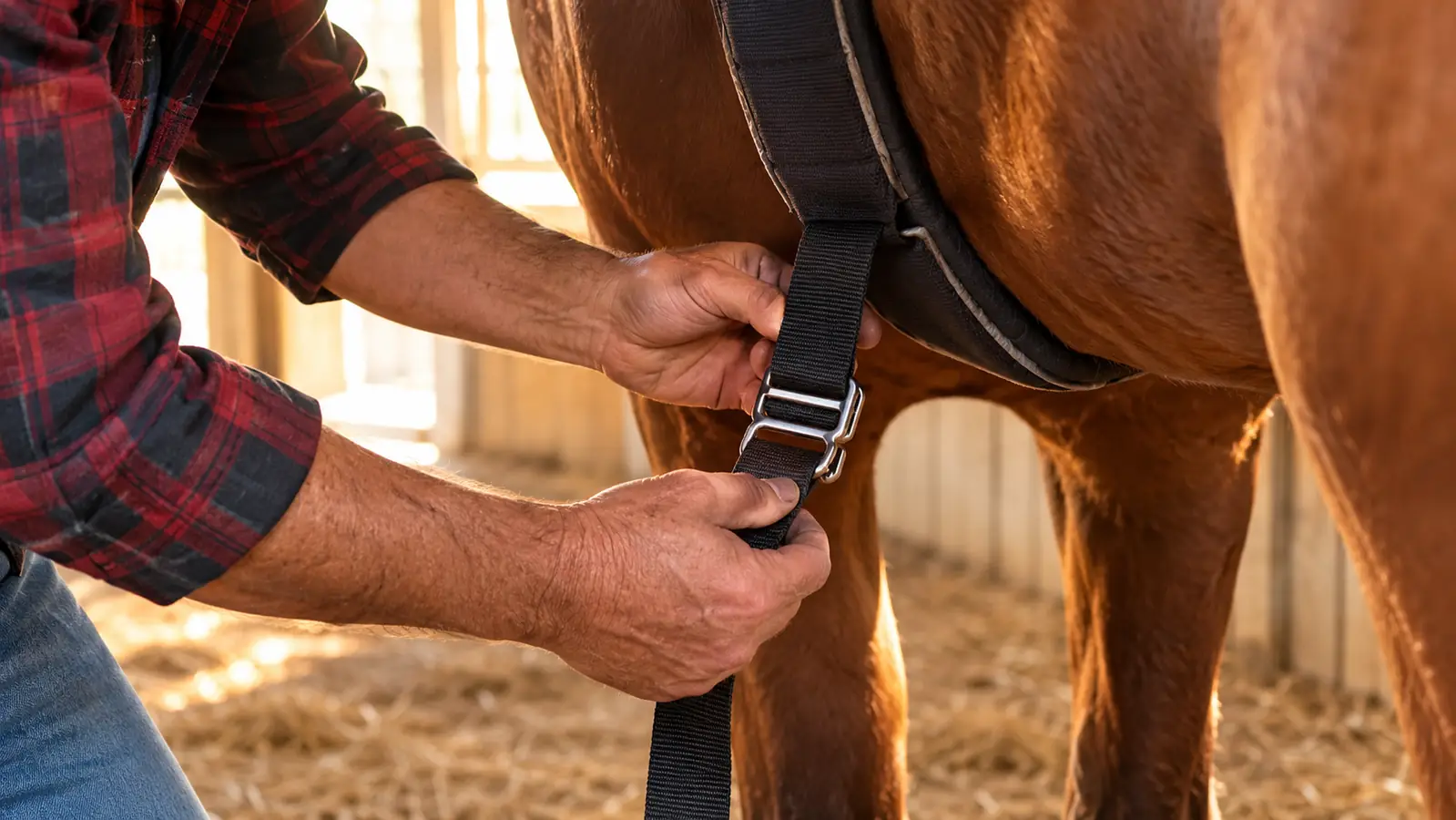
Two measurements, both with the horse standing square on level ground. First, the heart girth: run the tape all the way around the barrel, up behind the withers and down behind the elbows, snug but not pulled tight. Write the number on the stall wall. Second, lay your current cinch flat and measure it buckle to buckle. Those two numbers together tell you whether the cinch you have is the right length for the horse you have, and most of us have never checked.
The fit rule I go by is that the top of the cinch and the rigging rings should clear the point of the elbow by a couple of inches once the saddle is on and drawn up. A cinch that is too long rides forward and up into the elbow, which is exactly where a rub starts on a wide horse. A cinch that is too short pinches, and the horse hollows and fights you. If your saddle has more than one rigging position, and wide-withered horses often need the cinch set a little further back, that is a conversation to have with a saddle fitter rather than something to solve by buying three cinches and hoping.
Do not order a length because it is the length someone on a forum uses on a horse the same height. Height tells you almost nothing about barrel. Sarge is 15.1 and built like a barrel with legs, and the cinch length that suits him would be wrong on a narrower horse of the same height. Measure your own animal and order from that number.
Step 3: Put a cinch on it that spreads contact instead of grabbing
Here is the part that actually changed things for me. A string cinch makes contact along a few narrow cords, and every one of those cords can catch a fold of skin as it comes up. A felt lined cinch makes contact across a flat face. The Weaver Equine Felt Lined Smart Cinch has a durable poly webbing top, a 1/2 inch polyester felt liner that goes against the horse, and non-rust stainless steel hardware. That is the whole design, and it is enough. The felt spreads the pressure and, just as importantly, it does not grab the way cord does.
The liner matters in hot weather too. Felt breathes and takes up sweat instead of trapping it against the skin the way a slick surface does, and a cinch area that stays drier is a cinch area that stays less irritated. The unit weighs about 1.5 pounds, so it is not a lightweight cord cinch you forget you put on, but it is not so heavy that it drags the saddle around either. Mine has been on the same saddle through three full riding seasons and the hardware has not rusted or seized.
I will be straight with you about what this cinch will not do. It will not fix a saddle that bridges, and it will not fix bars that are the wrong width for your horse. If your saddle is rocking or pressing in front, a new cinch just changes where the sore shows up. I had a fitter look at my saddle before I spent anything on tack, and I would tell anyone with a wide-withered horse to do that first. The cinch solved the friction problem. It did not solve the fit problem, and I do not pretend otherwise.
Step 4: Change the order you tighten in
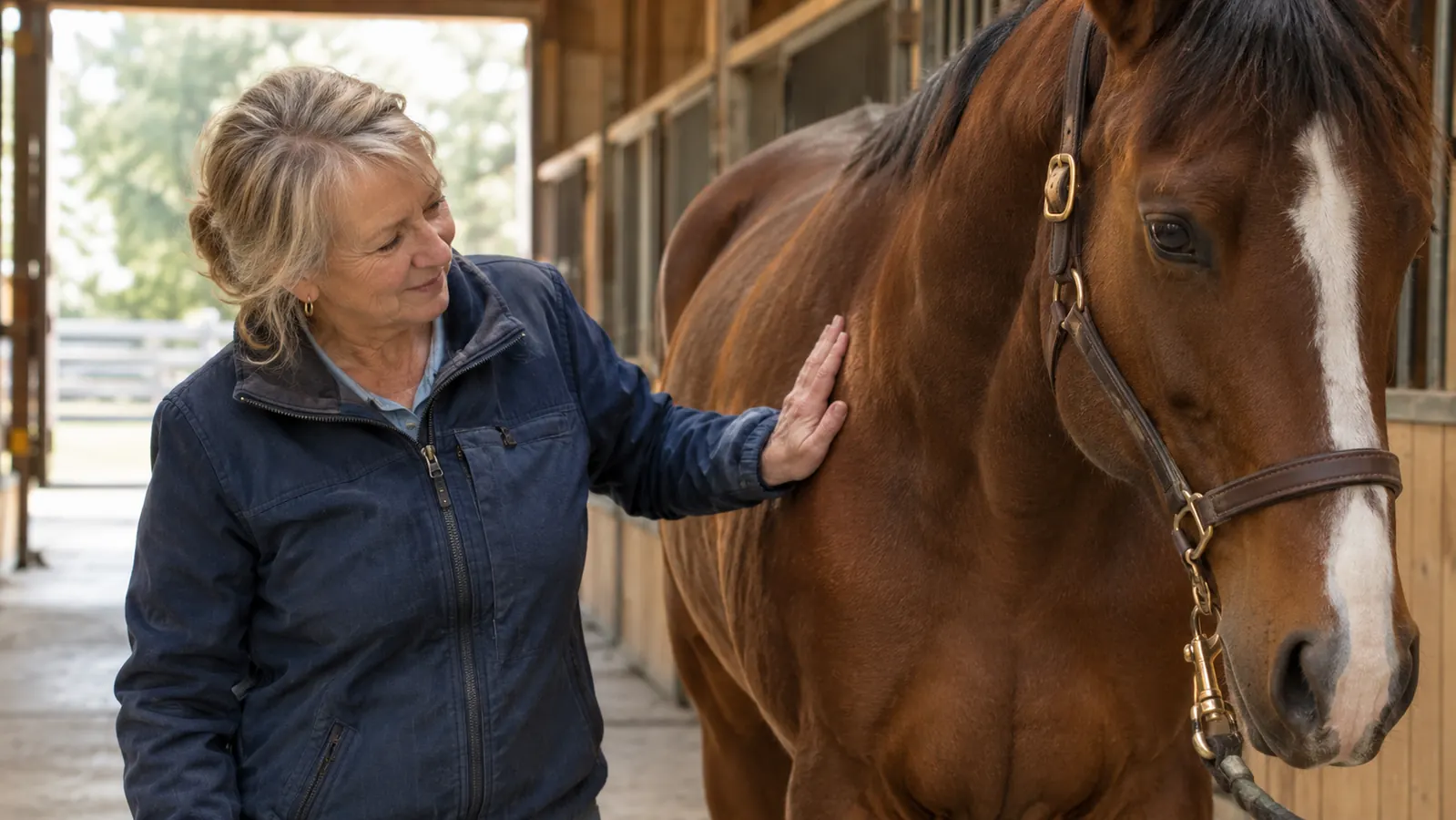
Most cinch sores I have seen, including the one on my own horse, were made worse by a rider pulling the cinch down hard to stop the saddle from slipping. On a wide-withered horse that is a trap, because the saddle slips for fit reasons, not for lack of tightness, and cranking it down just drives the cinch forward into the elbow while the horse braces against it. Tighten in stages instead. Enough to hold the saddle while you mount from a block, then a walk around the arena or down the first stretch of trail, then take up the last two holes.
Give the horse a chance to relax between stages. A horse that is bracing has a hard belly, and a cinch pulled tight against a hard belly sits wrong and rubs. I lead Sarge a few laps before I get on, which also lets me watch whether the saddle is creeping forward. If it is, I get off and deal with the cause rather than reaching for the cinch again.
Check it once more about a mile in, and once at the end before you untack. Not to tighten it further, but to see where it has ended up. That habit is how I caught the early stage of the next rub rather than the sore stage.
Step 5: Let the spot heal and keep the cinch clean
You cannot ride through a cinch sore and expect it to improve. Sarge got about three weeks off, turned out as usual, with the spot kept clean and dry and nothing smeared on it that would hold dirt. It closed over in that time and the hair grew back. If the spot is hot, swollen, or your horse flinches when you touch it, that is a vet call, not a tack change. And do not put ointment on a sore and then cinch over the top of it, because all you have done is make the friction worse in a greasy place.
Then there is the cinch itself, which is where most people undo their own good work. Felt holds hair and dried sweat, and a matted felt liner grabs exactly like the cord cinch you replaced. I brush mine out with a stiff brush after every ride, before it goes on the hook in the tack room. It does not go in a bucket, it does not get balled up in the trailer, and it never goes back on the saddle damp. That is thirty seconds of work and it is the reason the liner still looks like a liner.
When you start riding again, go short first. An hour on the trail, untack, check the spot. If it is cool and quiet, add time next ride. That is how I eased Sarge back in, and it is how I would do it again.
What Else Helps
Fix the saddle before you fix the cinch, if you can only afford one. A wide-withered horse needs bars that match the angle of his shoulder, and no cinch on the market will compensate for a gullet that is too narrow. A fitter who will watch you ride is worth more than any piece of tack in this article, and I say that as someone who sells nothing. The second thing is the pad. A pad that is too thick in front tilts the saddle back and puts the pressure on the loin, and a pad that has gone hard and compressed does nothing at all. Wash it, and replace it when it stops springing back.
The third thing is patience with the heal. I tried tightening the cinch harder first, before I understood any of this, and it made the rub worse within two rides. I also tried a thicker pad, which pushed the saddle up in front and made the whole thing sit worse. Neither cost me much, but neither helped, and the thing that actually worked was the least dramatic option: a cinch with a flat felt face, the right length, and less tension. If you take one thing from this, take that.
Three weeks of rest closed the spot. Two and a half years on a felt lined cinch, three rides a week, and it has not come back.
Measure your horse, then order the felt lined cinch
Poly webbing top, a 1/2 inch polyester felt liner against the horse, non-rust stainless steel hardware, and a maker warranty of always guaranteed. Brush the liner out after every ride and it will outlast the saddle it is on.
Amazon Check Today's Price on Amazon →