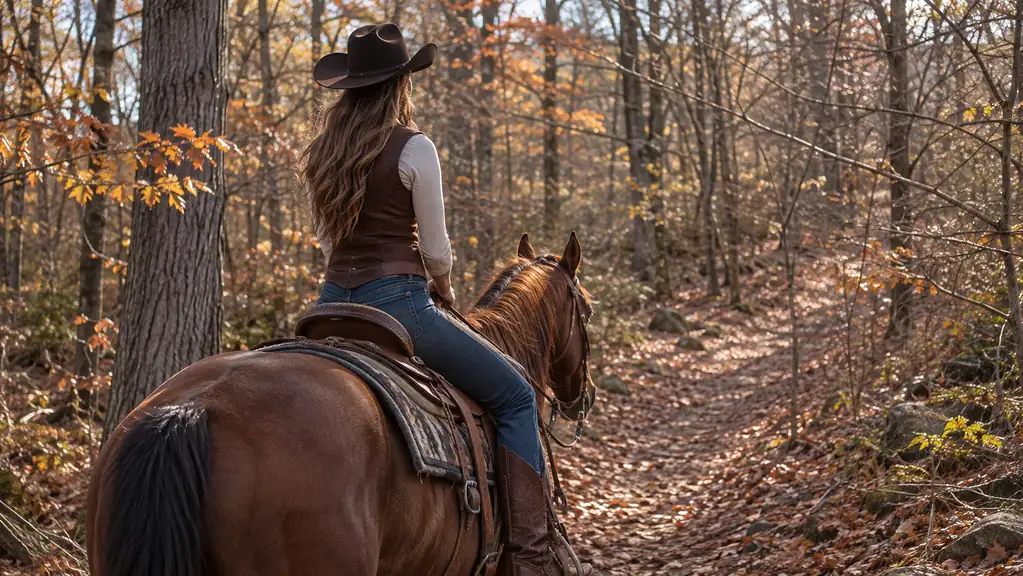
By the third hour in the saddle my tailbone starts sending messages, and by the fourth I am standing in the stirrups at every walk break, telling myself I will cut the ride short. I have ridden trail for better than thirty years and saddle soreness is the one thing that never got better with practice. It got better with a handful of small changes and one piece of gear I wish I had bought a decade sooner.
Here is what I got wrong for years. I treated my own soreness and my horse's soreness as one problem. They are not. Sarge, my sixteen-year-old Quarter Horse gelding, gets sore across the back when a saddle bridges or a cinch rubs. I get sore in the seat bones and hips because I am sixty-one and I sit like a sack of feed for four hours at a stretch. A gel seat pad like the Weaver Equine one I bought in spring 2025 does something for the second problem and nothing at all for the first. That distinction is where this whole article starts.
The pad that goes under you, not under the saddle
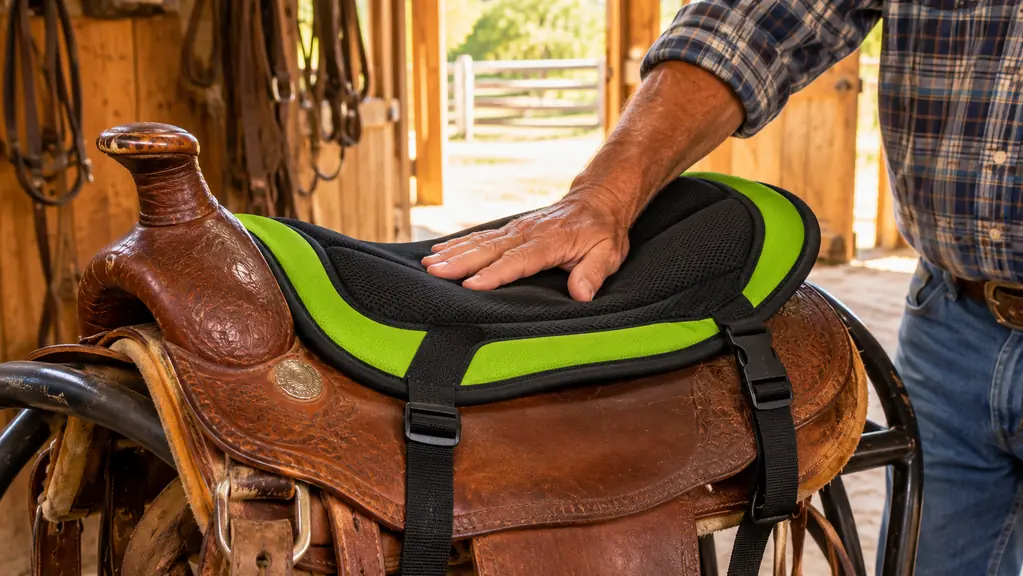
Weaver Equine's gel seat pad straps over the top of the saddle seat and contours to 15, 16 and 17 inch western seats. It weighs two pounds. It is not a fix for a saddle that does not fit. It is a fix for a long day in a saddle that does.
Amazon Check Today's Price on Amazon →Step 1: Separate Your Soreness From Your Horse's
Ride, then untack, then look. That is the whole test. If Sarge flinches when I run a flat hand down either side of his spine, or if there is heat or a dry patch in the hair where the saddle sat, his problem is the saddle or the pad underneath it. If his back is cool and quiet and I am the one hobbling to the truck, my problem is the seat and how long I stayed in it. Two different problems, two different places to spend money.
For several years I had this backwards. I kept adding blankets under the saddle to soften my own ride, which changed the fit of a saddle that already fit reasonably well and did Sarge no favors. Padding under a saddle is not free. It lifts you, it narrows the channel, and it can turn a decent fit into a tight one. If you want to soften the seat, you soften the seat. If you want to soften the horse's back, you look at the saddle, the pad and the cinch.
So the first step costs nothing. Decide which end of the horse the problem is on. Most of us have some of both, and it helps to know which one is louder before you open your wallet.
Step 2: Check the Fit Before You Buy Anything
My saddle is a secondhand Western trail saddle with full Quarter Horse bars, bought used about twelve years ago. The leather has gone dark with age and it has been re-oiled more times than I can count. Sarge has wide withers, and that has made fit a genuine problem from the day I brought him home. Wide withers are why I have learned more about saddle fit than I ever wanted to.
Here is the short version of what I check after a long ride. I look for even sweat marks and no dry spots, which would tell me the weight is sitting in patches instead of spread out. I check that I can see daylight through the gullet at the withers with me in the saddle. I run a hand under the front of the saddle to feel for bridging, where the saddle rocks and only touches at the front and back. I watch Sarge's attitude on the downhill, because a horse that shortens his stride going down is telling you something.
If any of that looks wrong, stop reading here and get a saddle fitter out. I am not one and I am not a vet. A pad, a gel seat, a different blanket, none of it repairs a saddle that does not fit. What I am describing in the rest of this article assumes your horse's back is sound and the saddle is close to right.
Step 3: Put a Gel Seat Pad on Top, Not Under
I bought the Weaver Equine gel seat pad in spring 2025 for a plain reason. Rides over two hours were leaving my hips and tailbone aching for a day afterward, and I was starting to skip the long loops at the Kickapoo Valley Reserve because of it. I noticed less ache within the first month. Not a transformation, just a ride that ended with me still willing to do barn chores.
The pad is a gel seat pad, which means it straps onto the top of the saddle seat and sits under the rider. It never touches the horse. The listing gives its dimensions as 13 by 0.5 by 24 inches and its weight as two pounds, with a gel insert, a mesh cover, a nylon material and a strap closure. It is built to contour within 15 inch, 16 inch and 17 inch western seats. Eighteen months in, mine lives on the saddle on the rack in the tack room between rides, which tells you how much fuss it is.
What it does not do is just as important. It does not change saddle fit. It does not distribute anything across your horse's back. It does not make a hard, worn-out saddle into a good one. If your horse is the sore one, this pad is the wrong purchase and I would rather tell you that than sell you something.
One honest note on the mesh cover. The idea is airflow, and I do think it helps compared to a solid pad, but an August afternoon in Wisconsin is still an August afternoon. You will get warm. The difference is that the pad does not turn into a wet sponge the way a fleece cover does.
Step 4: Build Up the Hours Instead of Jumping to Four
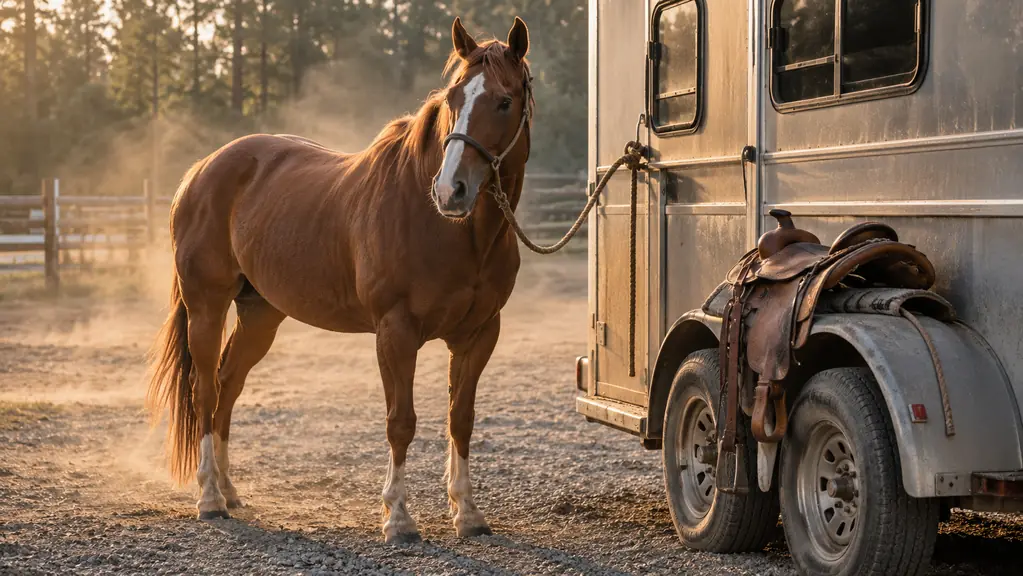
I ride Sarge about three times a week from April through November, and my longest regular ride is around four hours. I did not get there in a week in the spring. Both of us need a runway, and the older I get the longer the runway is. The first rides of the season are forty minutes and I do not apologize for it.
On a long ride, I get off and walk. Not because something is wrong, just because standing on the ground for five minutes resets everything. I also stand in the stirrups at a walk for a hundred yards or so, a few times over the course of a ride. It is not elegant and it is not dressage, but it takes the pressure off the same two square inches of my body for a minute at a time.
The other half of this is your own condition, and I say that as a woman who spent twenty years behind a desk. If your hips are tight and your core is weak, four hours in a saddle will find it no matter what pad you buy. Walking in the evenings and a few stretches before I mount up have done more for my seat than any single piece of tack.
The pad weighs two pounds and never touches the horse. It sits under me, and that turned out to be exactly the problem it needed to solve.
Step 5: Fix the Small Things That Rub
Long rides do not just hurt your seat. They find every small rub and grind it into a real problem. In April 2024 Sarge came up with a rub behind his left elbow from an old string cinch. It was angry and I felt awful about it. I switched him to a felt lined Smart Cinch, rested him about three weeks while it healed, and it has not come back since. I brush the felt out after every ride and hang it on a hook in the tack room. Do not guess at size, measure your own horse.
The other thing that wore on me was reins. I had old leather split reins and I dropped them, repeatedly, and stepped on them at least twice. In summer 2025 I switched to a poly roper rein, one continuous loop, 3/8 inch by 8 feet, with leather water loops and scissor snaps. It stays clipped to the bridle on the tack room peg. One loop is one less thing to fumble when you are tired and the light is going.
And the unglamorous daily items. Sarge's padded nylon halter is a size Average Horse and hangs on a hook outside his stall. It never stays on him in the pasture or the stall, because halters and fences do not mix. For the saddle, I have used Fiebing's yellow saddle soap, the 3.5 ounce tin, for about three years now and I am on my third one. I clean the saddle roughly once a month in riding season, then follow with a separate conditioner when the leather feels dry. Clean, supple leather sits and moves better than stiff leather, and that matters over four hours.
What Else Helps
Check your saddle's stitching once a season, especially the billet straps and the stirrup leathers. I have had a stitch let go on a rear cinch and I was lucky it happened in the barn and not a mile out. Anything that holds your weight or your leg deserves a hard look in good light, with a rag to wipe off the dust so you can actually see the thread.
Pay attention to the ground you are riding on. Hardpack and gravel beat you up more than soft field edges, and a long ride on frozen ground in late fall will find soreness that a summer ride never touches. If I know the footing is going to be hard, I shorten the ride and I do not feel bad about it.
And know when to stop. Heat, swelling, a flinch when you groom, a horse that is short on one lead, a rider with numbness or pain that lasts past the next morning. Those are not tack problems. Call your vet or your saddle fitter and let them look. I have been lucky with Sarge, one cinch rub in all these years, and a good part of that luck is that I quit early when something felt off instead of pushing through a beautiful afternoon.
Eighteen months in, mine still lives on the saddle rack
The Weaver Equine gel seat pad straps over the seat of a 15, 16 or 17 inch western saddle, weighs two pounds, and carries a satisfaction guarantee. If the soreness is in your seat and not in your horse's back, this is the cheapest thing to try first.
Amazon Check Today's Price on Amazon →