
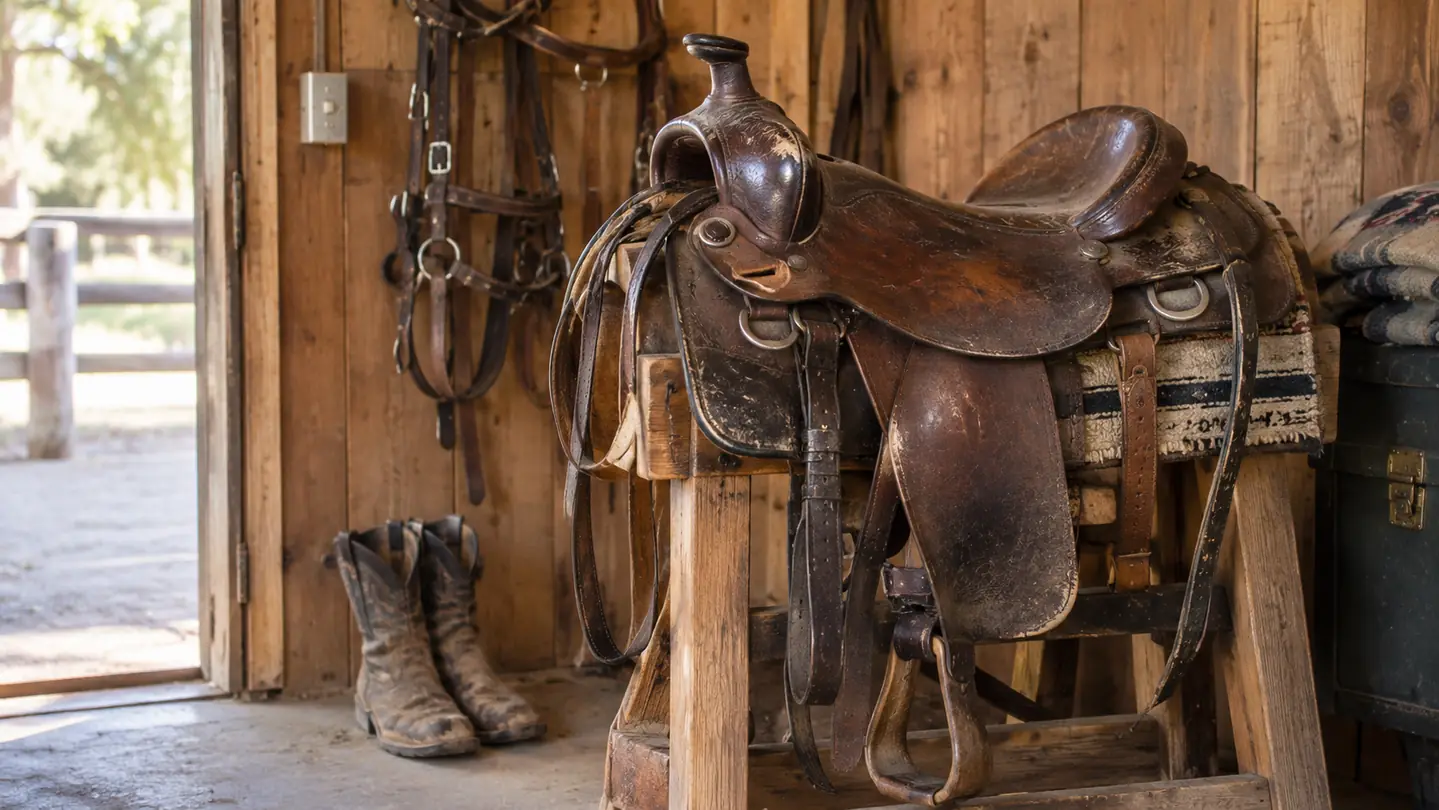
I am on my third tin of Fiebing's saddle soap and I want to be straight with you about what that means. I bought the first one in the fall of 2023, when the secondhand Western saddle I had ridden for a dozen years had gone pale and dry along the fenders and the skirt. I bought the third one this past spring. Three tins in three years is not a dramatic story. It is what an honest review of a saddle soap looks like, because the stuff is not dramatic. It cleans leather, it does that job well, and it does not do every other job people hope it will.
Here is the part nobody tells you in the aisle at the feed store. Saddle soap is a cleaner. Your grandfather's saddle soap, my grandfather's saddle soap, and this one. The label on the Fiebing's tin calls it a cleaner and conditioner both, and I will get to that claim, because it matters more than the marketing copy suggests. But if you are buying this hoping it will bring a cracked, dried-out saddle back to soft, you will be disappointed, and the soap will not be the thing that let you down. Your expectations will.
The Quick Verdict
A dependable leather cleaner in a small tin that lasts about a year of monthly cleanings on one saddle. It is not a conditioner, and the label oversells that half of the job.
Amazon Check Today's Price →The tin I end up replacing about once a year
If what you need is a cleaner that lifts sweat and dust out of smooth leather without leaving a film behind, this is the one on my tack room shelf. Check the current listing for the tin size before you order.
Amazon Check Today's Price on Amazon →The Honest Version of What This Product Is
Fiebing's has been making leather care for a long time, and this is their plainest offering: a paste soap, unscented, in a small round tin, listed for fine saddlery, boots, shoes and other smooth leather. It is not a cream. It is not a balm, an oil, or a salve. You use it with a damp sponge, you work up a little foam, you wipe the dirt away, and you stop. That is the whole routine, and it takes maybe twenty minutes for a saddle if you are thorough.
I learned the limits of it on my own saddle. Back in 2023 the leather on the fenders and the skirt had that pale, thirsty look that old tack gets when nobody has fed it in years. I cleaned it well with this soap and it looked better, genuinely better, but it still felt stiff under my hand the next morning. It took a separate conditioner, worked in after the soap had dried, to bring the feel back. Nobody at the feed store told me that. The tin does not tell you that either.
Glycerine soap is the other thing on the shelf, and I have used both. Where glycerine soap is a bar you rub on and it lathers freely, this is a paste in a tin, and paste takes a little more judgment. You load the sponge lightly and you keep it moving. Load it heavy and you spend the second half of the job wiping foam out of stitching instead of cleaning leather. The first few times I used it I overloaded it, and I could feel the difference in how the sponge dragged across the fender. Now I touch the surface of the paste once, maybe twice, for a whole fender, and the tin lasts accordingly.
How I've Used It
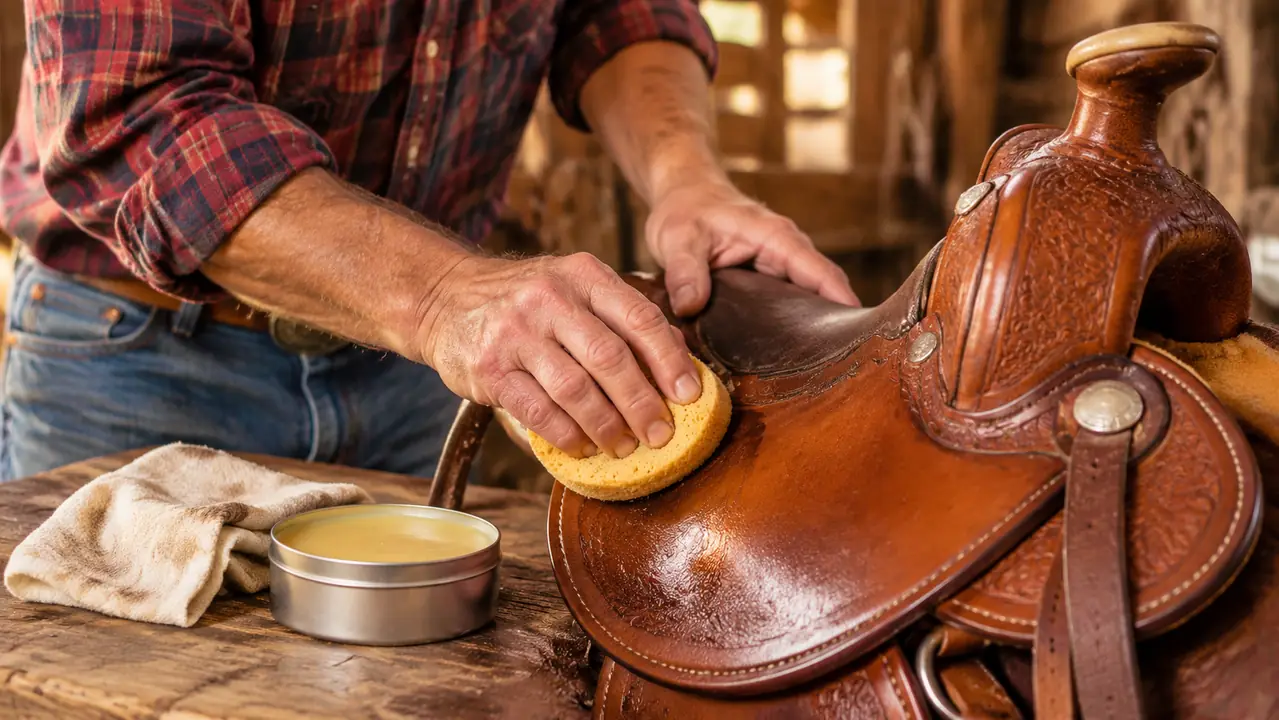
Once a month through riding season, which for me runs April into November, I pull the saddle off the rack and clean it. Sarge gets ridden about three times a week and our regular long ride runs around four hours, so the leather picks up sweat, dust and horse. I wet a sponge, wring it out until it is barely damp, and pick up a little of the paste. You do not need much. A fingertip's worth does a fender.
I work it in small circles, wipe the dirty foam off with a clean rag, and let the leather sit a while before I decide anything. Then I check how it feels under my hand, not what the calendar says. In a wet Wisconsin summer I condition less often. In February, with the woodstove going out in the tack room, I condition more. The soap is the same either way. The conditioner is what changes with the weather.
Last October I did the job on a Tuesday afternoon after a four-hour ride out on the Kickapoo Valley Reserve, the kind of ride where you come back with a wet mark on the saddle skirt the shape of your leg. I pulled the saddle onto the rack, filled a bucket at the hydrant, and wrung the sponge out three times before I touched the tin. Warm water makes the paste take up faster and the sweat lifts easier while the leather is still a little damp. Twenty-five minutes later I had a clean saddle, a gray rag, and a sponge that needed rinsing in the same bucket. The whole job is that unremarkable, which is the point of it.
My husband Dale has watched me do this once a month for years and still cannot tell the before from the after unless I point at the tooling. He is not wrong to be unimpressed. Cleaning a saddle is maintenance, not transformation, and a product that made a saddle look dramatically different after one session would worry me more than it impressed me.
It has held up through three years of that schedule on one saddle, plus boots, plus a bridle now and then. The tin lives on the shelf between cleanings, lid seated, and it has never leaked or gone rancid on me. That sounds like a low bar. If you have opened a tin of something in March and found it turned, you know it is not.
What It Does Well
It cleans smooth leather properly. The saddle takes on sweat, dust and horse three rides a week, and this soap lifts all of it without stripping the finish down to suede. Where the leather is tooled, the paste works down into the cuts and pulls the dirt out, which is the part I notice most, because a brush alone never reaches it. I have cleaned the same tooled skirt for three years and it still shows its pattern instead of a gray smear.
The parts I worry about are the ones a heavy hand ruins: the stitching along the skirt, the thin leather where the fender turns down through the rigging, and the keepers that hold the off billet. I have gone over all of those with this soap and none of them have gone soft, curled or dried out at the edges. That is the test I run on a cleaner now, more than how the seat looks, because a seat that shines and a fender that has given up its shape is a saddle with a real problem.
It leaves nothing behind. No oily film, no tacky feel, no scent. The tin is unscented and stays that way. My saddle does not smell like a candle, and after thirty years of riding I have come to appreciate that more than I would have at twenty-five. It rinses out of the sponge, too. Some pastes leave a sponge slick and hard to bring back, and I have thrown sponges away over exactly that. Mine gets a rinse in the bucket and hangs to dry on the edge of the shelf.
And it is mild. The tin lists water resistance among the product's features, and my experience agrees with that. A damp sponge is part of the process anyway, so a soap that could not tolerate water would be a strange product to sell. What matters to me is that the leather does not go soft, spotty or slick afterward, and mine has not, including on the straps where the leather is thin.
The Mistake I Made First
For the first year I owned this tin, I used it like a conditioner. I would clean the saddle and then, because the leather still felt dry, I would go back over it with more soap and leave the residue on overnight, thinking it would soak in. It did not soak in. It dried into a pale film that took a damp rag and some patience to get off, and the leather underneath was exactly as thirsty as before. Soap is not a poultice. Leaving more of it on does not make it behave like one.
The other mistake was cleaning too often. I went weekly one muddy spring because I figured more was better. What I got was flat, dull-looking leather by June, and it took me most of the summer to connect the two. Once a month, plus a wipe-down with a damp rag after a muddy ride, has been kinder to the saddle than a scrubbing every week ever was.
Where It Falls Short
It is not a conditioner, and the label is loose about that. Fiebing's calls this a cleaner and conditioner paste. I have used it for three years. It cleans. Whatever conditioning it does is light, the kind that comes from any soap with a little fat in it, and it is not enough for leather that has genuinely dried out. When my saddle has felt stiff, the fix was a separate conditioner, unbranded, worked in after the soap had dried. If you buy this and stop there, you will be back in a year wondering why your leather is still thirsty.
The word smoothening appears in the listing's product benefit field, and I think it is the most honest single word on there. Soap smooths. It does not rebuild. My skirt has a scuff from the stirrup leather that was there when I bought the saddle and is still there now, and three years of cleaning has not changed it, because a cleaner cannot. If what you want is for the surface to look new again, no soap does that, and the products claiming otherwise are the ones I trust least.
Worth saying plainly: this does nothing for the horse. It is not a treatment of any kind. If your horse has a sore back or a rub, the answer is a saddle fitter or a vet, and possibly a different pad, not a cleaner. I say that because I have watched people buy leather products hoping a riding problem would solve itself, and I have been one of those people.
The paste stiffens in a cold tack room. Mine sits on a shelf in a two-stall pole barn with no heat, and by February the surface is firm enough that I have to work the sponge harder to pick any up. It is not ruined. It is just less pleasant to use in winter, and I have learned to bring the tin into the house from December to March.
The listing reaches wider than the job. It mentions car seats, couches, shoes, purses and bags, and I have used it on work boots with no complaint at all. But a sealed, finished automotive interior is a different material from a piece of tack leather, and this is not the product I would reach for on a modern car seat. It will clean a boot that has been in the barn. That is the honest scope of it.
The Tin Itself and How Far It Goes
Three tins in three years works out to roughly one a year, for one saddle cleaned about once a month from April through November. That is the number I would want if I were reading this instead of writing it. Call it eight to ten cleanings a tin, fewer if you are generous with the sponge, more if you are careful. The tin is a 3.5 ounce size, about 100 ml, measuring 3.68 inches across and 1 inch deep.
One tin is small if you have more leather than I do. A saddle, a bridle, a headstall and a pair of boots is my whole rotation. If you are doing a breast collar, a full set of saddlebags and four sets of reins in an afternoon, this tin will not go as far as you are picturing. There is no warranty on the tin either, which tells you what Fiebing's thinks the failure mode is, and they are right about it, because the failure mode is you leaving the lid off and coming back to a hockey puck.
What I Liked
- Lifts sweat, dust and grime out of smooth leather without stripping the finish
- Unscented and leaves no oily film or tacky feel behind
- A tin lasts about a year of monthly cleanings on a single saddle
- Works down into tooling in a way a brush alone does not
- Small and light enough to live on a shelf or in a tack trunk without notice
Where It Falls Short
- The conditioner claim on the label is generous, dry leather still needs a separate conditioner
- The paste firms up in an unheated tack room through the winter
- One 3.5 ounce tin will not cover a large tack collection
- Despite the listing copy, it is not the right product for sealed automotive leather
One tin does about a year of monthly cleanings on one saddle. That is the most useful number I can give you, and it is the one nobody puts on the label.
Who This Is For
You keep one or two horses, you clean your own tack, and you want a straightforward cleaner that will not leave a residue or a smell on your hands. You already own, or are willing to buy, a separate conditioner and you understand that those are two different jobs done by two different tins. You clean on a schedule instead of waiting for a crisis. You like a product that sits on a shelf and does not go bad between uses.
That is me, plainly. After three tins I would buy the fourth without thinking about it, and I would still tell a friend to put a conditioner next to it on the shelf. The soap has done its job for three years on a saddle that was already old when I bought it. I ask it to do that and nothing more.
Who Should Skip It
If your leather is already cracked, dried out or stiff as a board, this is not the rescue. Buy a conditioner, or take the saddle to someone who knows leather, and use soap only once the leather has come back to itself. Soap on dry leather is like washing your hands without lotion in January. It is not harmful, it is just not the thing that was needed.
Skip it too if you want a single product that cleans and conditions in one step. No soap does that well, whatever the label says, and you will spend a season learning what I spent a season learning. And skip it if you are shopping for a modern car interior. The listing copy will follow you there. The product will not do what you are picturing.
Three tins in, I still keep one on the shelf
If your tack is sound and just dirty, this is the cleaner I would hand you across the tack room. If it is dry, buy the conditioner too, and use them in that order. Check the current listing for the tin size before you order.
Amazon Check Today's Price on Amazon →