
Two soaps live on the shelf in my tack room and I use both of them. Fiebing's saddle soap in the 3.5 ounce tin is what I reach for when my saddle has gone a month without attention and the leather looks dry and dull. A glycerine saddle soap bar is what I grab when the ride was dusty and I want the grit off before the saddle goes back on the rack. Short answer: if the leather needs cleaning and feeding, the Fiebing's paste wins. If the leather is already in good shape and you want it clean in ten minutes, the bar wins. The rest of this page is why.
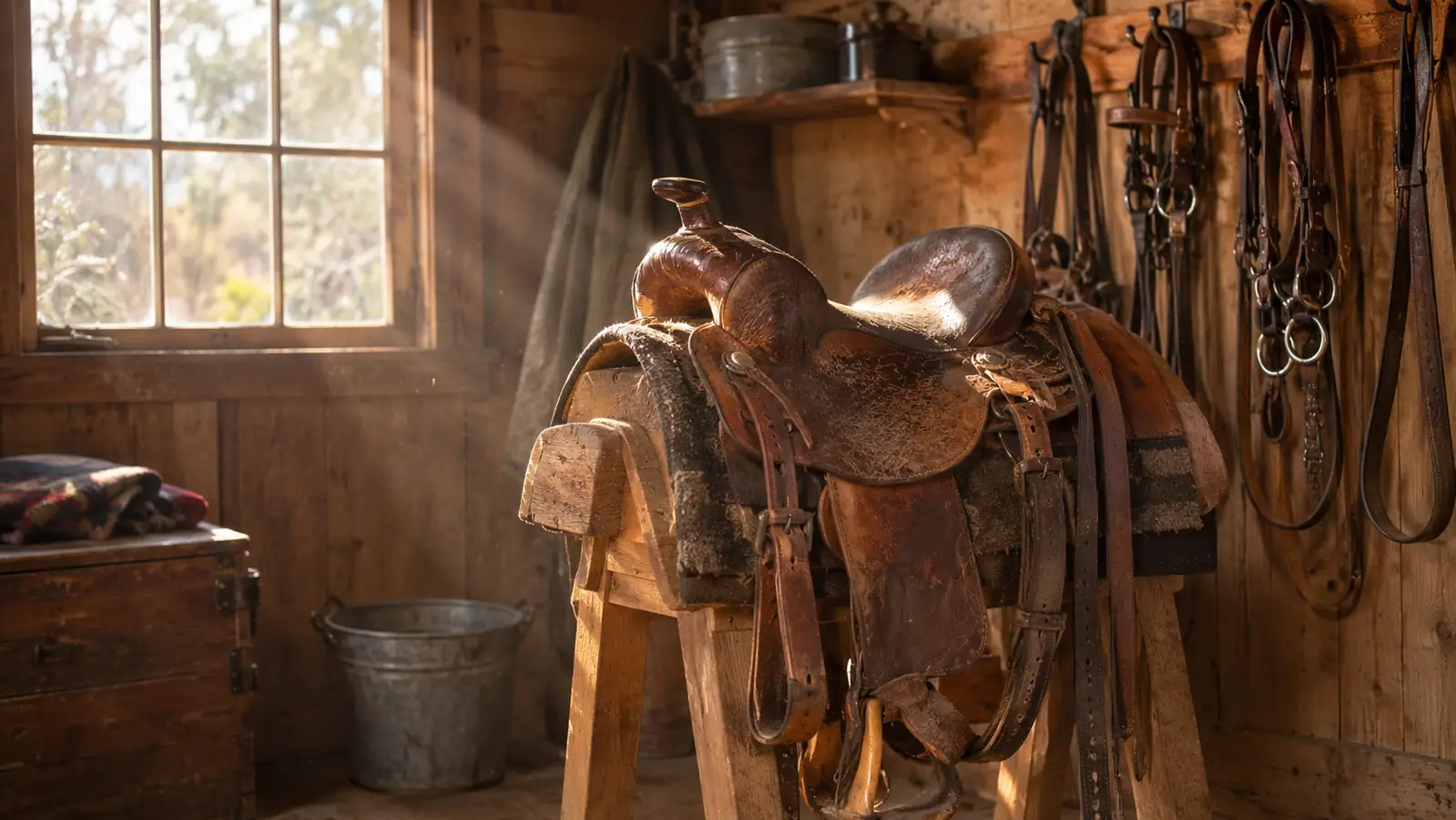
I'm Corinne Tollefson. I'm 61, retired from dispatching school buses, and I keep one horse on eleven acres outside Viroqua, Wisconsin. Sarge is a 16-year-old Quarter Horse gelding, 15.1 hands, about 1,100 pounds, with withers wide enough that saddle fit has been a running conversation for years. One saddle: a secondhand Western trail saddle with full Quarter Horse bars, bought used about twelve years ago, the leather darkened with age. I've used Fiebing's since the fall of 2023, I'm on my third tin, and I clean that saddle roughly once a month from April through November. I've kept a glycerine bar around since the summer of 2025, the Joseph Lyddy one, because I wanted to know whether I was doing unnecessary work every month.
| Fiebing's Saddle Soap | Glycerine Saddle Soap | |
|---|---|---|
| Form | Paste in a 3.5 ounce tin, worked up with a damp sponge | Hard bar rubbed on a wet brush or sponge |
| Ground-in dirt | Cuts through a season of sweat marks, dust and grime in the skirt and fenders | Lifts light surface dirt, works harder on caked-on grime |
| Conditioning | Sold as a cleaner and conditioner in one; leather feels fed afterward | Cleans only; you follow with a conditioner either way |
| Leather gone dry and dull | Brings a thirsty used saddle back to something you can work with | Does very little for leather that is already dry |
| Quick wipe-down after a dusty ride | More soap than that job needs | Ten minutes and back on the rack |
| Residue and finish | Leaves a film if you are heavy-handed and skip the buff | Buffs clean with almost nothing left behind |
| Thin leather and stitching | Paste can load up seams and thin straps | Gentler on thin leather and stitched edges |
| Scent | Unscented on the listing | A light soap smell that fades |
| Time per saddle | About twenty minutes plus a buff | About ten minutes start to finish |
| Best for | A saddle cleaned monthly that needs feeding, not just cleaning | Weekly touch-ups on leather already in good shape |
Where Fiebing's Wins
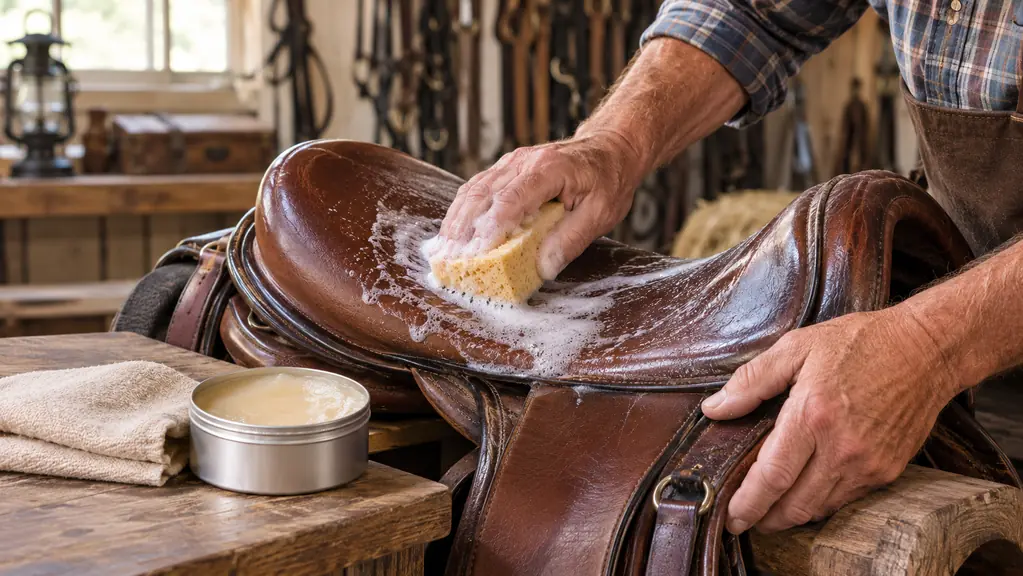
The paste does the two jobs I actually need done, and it does them in one pass. When I bought that saddle it had been sitting in somebody's barn, and the leather was dry enough that the fenders felt like cardboard. My first tin of Fiebing's changed that within two cleanings. I wet a sponge, wrung it out so it was damp and not dripping, worked a little paste into the sponge, and went at the seat and the fenders in small circles. The sponge came up brown, which is what you want to see. Then I wiped it dry with a rag and buffed it. The leather came back soft enough to be limber under my leg instead of stiff. No glycerine bar I have tried has done that on a dry saddle. Glycerine cleans. This one cleans and feeds, which is exactly what the listing claims for it as a cleaner and conditioner.
I can put a rough date on that first cleaning, because I remember standing in the tack room with the door open because the fall air was mild and I did not want to be closed in with the smell of old barn. It was October of 2023, a Saturday, and I gave the seat and both fenders a first pass, then a second pass maybe twenty minutes later because the sponge was still coming up brown. The seat came around first. The fenders took three monthly cleanings before they stopped feeling like something you would cut with a knife. By the following spring that saddle finally felt like mine instead of like something I had rescued.
The other thing I like is that it has no smell. The listing calls it unscented and that matches the tin on my shelf. I keep my tack in a small room off the barn and I don't want a perfume hanging in there over the leather and the felt pads. The tin itself is 3.5 ounces, a little over 3.5 ounces by weight on the listing, roughly 100 ml, and it survives living on a shelf in an unheated tack room through a Wisconsin winter without turning to stone. The tin measures about 3.68 inches across and an inch tall, which matters more than you would think, because it fits in the little wooden box where I keep the sponge and the rag and a hoof pick. When I clean in the trailer at a trailhead, that tin goes in a zip bag and comes out in one piece.
My one caution is that a little goes a long way and it is easy to overdo. Load the sponge like you are frosting a cake and you will be buffing film out of the tooling for an hour. Two light passes beat one heavy one. I learned that the hard way on a set of stirrup leathers in the spring of 2024, and I ended up wiping them down twice with a clean damp rag to get the shine back to something that looked like leather instead of varnish.
Where Glycerine Soap Wins
The glycerine bar wins on the ordinary days, and there are more ordinary days than big ones. Most of my rides are two to four hours on the Kickapoo Valley Reserve or the county trails, and most of them end with dust in the leather and sweat under the skirts. That is not a deep cleaning job. That is a rinse-and-wipe job. I wet a stiff brush, work up a little lather on the bar, scrub the panels and the fenders, wipe with a clean rag, and hang the saddle up. Ten minutes, no film, no buffing. If I used the paste that often I would be spending twenty minutes a week on a saddle that only needed ten.
It is also the one I trust on thin leather and on stitched edges. My breast collar straps and the keepers on my bridle are thinner than the saddle leather, and paste worked in with a sponge can load up a seam line and sit there. Glycerine lather rinses out of stitching far more easily. I tested this on a spur strap that had gotten stiff, and the bar cleaned it without leaving anything in the stitching to work back out. A bar also lasts a long time, and it does not care if you leave it in a bucket in the trailer overnight. The Joseph Lyddy bar I bought in the summer of 2025 has barely changed shape. I have washed maybe thirty saddles with it and I can still read the stamp on the face. For small leather goods, spur straps, and a horse that gets groomed and tacked up five days a week, that is hard to argue with.
How I Use Each One
For the monthly clean I use Fiebing's. Damp sponge, a small amount of paste, small circles over the seat, the fenders, the skirts and the stirrup leathers. I keep the sponge damp and rinse it once or twice so I am lifting dirt off rather than pushing it around. Then a dry rag to take off the residue, then a buff with a soft cloth. If the leather still feels dry when it is cool to the touch, I follow with a separate conditioner a day later. The soap is soap. It cleans and it feeds a little, but a saddle that has been rained on and dried out needs more than a cleaner.
I clean in the tack room, not in the barn aisle, because I want the saddle at chest height on the rack where I can see the tooling. My rack sits about three feet off the floor and that is the right working height for me at five foot four. I lay an old towel on the floor under it, because the damp sponge always drips and the concrete gets slick. Dale has commented on the wet spot on the concrete more than once and I have not fixed it yet.
For the after-ride wipe I use the glycerine bar. Brush, bucket of water, a few circles on the bar, scrub the dirty panels, wipe, hang it up. I do the girth and the cinch with plain water and a brush and let them dry flat. The saddle pad gets brushed out and hung, and the felt on my cinch gets brushed and hung on its hook. None of that needs soap of any kind.
The habit that matters more than either soap is doing it before you put the saddle away, not a week later. Sweat and dirt left on leather is what dries it out in the first place, and a saddle that came off a hot horse and went straight onto a rack in a cold tack room is the reason so many used saddles for sale look the way they do. I have bought exactly one used saddle in my life and I bought it because the woman selling it had wiped it down every single time she rode. You can tell. The leather on the underside of the skirts was as sound as the seat.
What I Liked
- Cleans and conditions in one pass, which is what a dry used saddle needs
- Paste clings where you put it instead of running off the fender
- Unscented, which matters in a small tack room
- A 3.5 ounce tin lasts a season of monthly cleaning, three tins in three years for one saddle
- 4.7 stars across more than 9,000 ratings, so I am not the only one who keeps buying it
Where It Falls Short
- Easy to over-apply, and too much leaves a film you have to buff out
- Needs a damp sponge and a clean rag and a buff, so it is a twenty minute job
- Not the tool for a ten minute wipe-down after a dusty ride
- Does nothing for cracked-through leather, which is past cleaning
Three years and three tins later, that used saddle has not gone back to the way it felt the day I brought it home.
What Neither Soap Will Fix
Neither soap puts leather back together. If your fenders are cracked through, if the leather around the stirrup leather holes is curling and splitting, or if a saddle came to you with mold in the fleece and mildew in the skirt, cleaning is not the answer. I have thrown out leather goods that were past it, and I would rather tell you that than sell you a tin. Mold needs to be dealt with as mold, and cracked-through leather needs a repair or a replacement.
Neither soap fixes fit, either. I spent two years blaming my own hips for how I felt after a long ride before I finally had somebody look at the saddle on Sarge's back. His withers are wide, the bars on my secondhand saddle are close for him, and no amount of soap changes that. If your horse flinches at saddling, if the sweat pattern under the pad is uneven, or if he has white hairs appearing at the withers, put the soap down and get a saddle fitter out. That is a fit problem, not a dirt problem, and a vet should see anything that looks like a sore or a swelling.
If the leather on your saddle feels dry and dull, this is the tin I keep replacing
Fiebing's saddle soap, a 3.5 ounce paste tin, rated 4.7 across more than 9,000 ratings. Unscented, sold as a cleaner and conditioner in one, and one tin gets me through a full season of monthly cleaning.
Amazon Check Today's Price on Amazon →Who Should Buy Which
Buy Fiebing's if you have one saddle, you clean it once a month or once a season, and the leather has been getting dry and stiff. Buy it if you picked up a used saddle and you don't know what it has been through, because that is precisely the job the paste does well. Buy it if you want to clean and feed in one pass instead of two, and if you don't mind twenty minutes with a sponge and a rag. It is also the one I would hand to somebody with a saddle that sat in a barn for two years, because the difference after two cleanings is the closest thing to a result I can show you.
Buy the glycerine bar instead if your leather is already in good shape, you ride four or five days a week, and what you actually need is a fast wipe-down that gets dust and sweat off without a buffing session. Buy it for thin straps, stitched edges, and small leather goods. Honestly, most people in my barn end up with both: the bar for the everyday work and the paste for the once-a-month job. If you are only buying one and your leather is tired, buy the paste.
Clean it before it dries out, not after
Start with the paste if the leather needs feeding. Add a glycerine bar later for the ten minute touch-ups between rides. Your saddle spends more hours on the rack than on the horse, and that is when the damage happens.
Amazon See the Fiebing's Tin on Amazon →